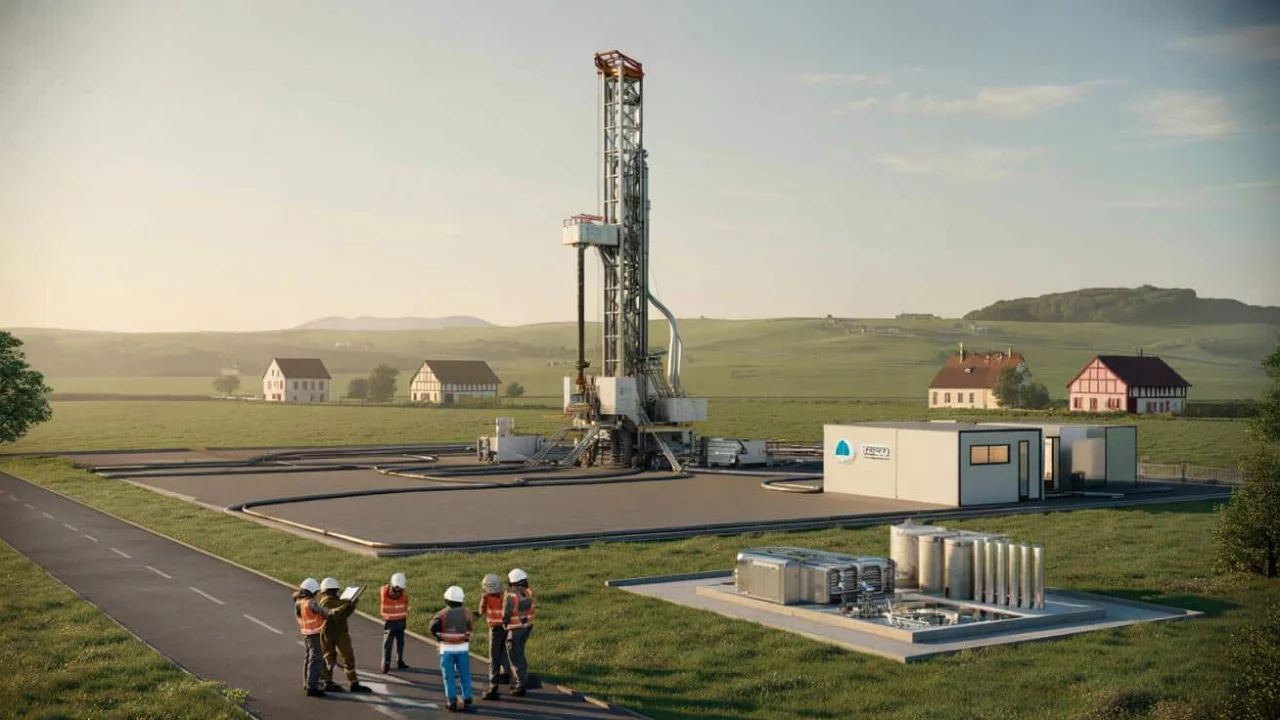
Marie Schwab has lived in the village of Schwabwiller her entire 68 years, watching seasons change across the same rolling fields where her grandfather once grew potatoes. But this November morning feels different as she peers through her kitchen window at something extraordinary: a massive drilling rig piercing the Alsatian sky, its steel frame rising like a mechanical cathedral above her quiet hamlet.
“I never imagined our little village would become part of something so important,” she says, clutching her morning coffee. “My neighbors are talking about jobs for their children, about heating that won’t cost a fortune. After decades of watching young people leave for the cities, maybe this will give them a reason to stay.”
What’s unfolding in Schwabwiller represents more than just another industrial project. It’s France’s ambitious bet on energy independence, wrapped in the promise of a technology that could simultaneously heat homes and power the electric vehicle revolution sweeping across Europe.
France’s Bold Vision for Alsace Lithium Drilling
Since November 24, 2025, French company Lithium de France has launched its groundbreaking geothermal drilling campaign in northern Alsace, marking a pivotal moment in Europe’s quest for energy sovereignty. The project, backed by the Arverne Group, represents a revolutionary approach to resource extraction that could reshape how France powers its green transition.
The Alsace lithium drilling operation targets underground reservoirs of naturally heated, mineral-rich water that lies deep beneath the Rhine Valley. This isn’t just about mining lithium—it’s about creating a integrated system where the same geological resource provides both clean heat for local communities and critical battery materials for electric vehicles.
“This project demonstrates that France can be innovative in addressing both our energy security and our mineral dependency,” explains Dr. Jean-Claude Mercier, a geothermal energy specialist at the French Geological Survey. “We’re essentially killing two birds with one stone, or rather, one drill.”
The drilling phase follows years of meticulous preparation. Between 2022 and 2023, extensive geological surveys mapped the underground landscape using 3D imaging technology. Environmental studies and community consultations led to regulatory approval in May 2025, clearing the path for the current drilling campaign.
Key Technical Details and Project Scope
The Alsace lithium drilling project employs sophisticated geothermal technology to extract maximum value from underground resources. Here’s how the process works:
Drilling Specifications:
- Drill rig height: 30 meters above ground
- Target depth: Several kilometers underground
- Expected water temperature: 150-200°C
- Drilling method: Geothermal doublet system
Resource Extraction Process:
- Hot, lithium-rich brine pumped from deep reservoirs
- Heat captured for district heating network
- Lithium separated from cooled brine
- Processed water reinjected underground
Project Timeline and Permits:
- 2022: Dual permits obtained for geothermal energy and lithium production
- 2022-2023: Exploration campaigns confirm viable reservoirs
- May 2025: Environmental permit granted
- November 2025: Drilling phase commences
The technology represents a significant advancement in sustainable resource extraction. Unlike traditional lithium mining, which requires massive open-pit operations and chemical processing, geothermal lithium extraction works with naturally occurring underground processes.
“The beauty of this approach is that we’re working with nature rather than against it,” notes Professor Elena Rossi, a mining sustainability expert at the Paris School of Mines. “The same geological forces that concentrate lithium in these brines also provide the heat we need for local energy systems.”
Economic and Environmental Impact on Local Communities
The Alsace lithium drilling project promises to transform northern Alsace into a hub of green industry. Lithium de France projects the creation of nearly 200 direct jobs, ranging from skilled drilling operators to processing technicians and administrative support staff.
For villages like Schwabwiller, the economic impact extends far beyond immediate employment. The district heating network will provide affordable, low-carbon warmth to homes, schools, and local businesses. This infrastructure could significantly reduce heating costs for residents while eliminating dependence on fossil fuel imports.
Environmental benefits include substantial carbon emission reductions. Traditional heating systems in the region rely heavily on natural gas and oil. The geothermal network could eliminate thousands of tons of CO2 emissions annually while producing lithium without the environmental destruction associated with conventional mining.
Local farmer Klaus Weber, whose fields border the drilling site, sees opportunity rather than disruption. “The company has been transparent about their plans,” he explains. “They’re offering fair compensation for land use, and the jobs will help our young people stay in the region. Plus, the geothermal heating could dramatically reduce our operational costs.”
The project also addresses Europe’s strategic mineral dependency. Currently, Europe refines very little lithium despite growing demand for electric vehicle batteries. The Alsace operation, while modest in scale, represents a crucial step toward reducing reliance on suppliers in Australia, South America, and China.
Dr. Marie Dubois, an industrial economist at Strasbourg University, emphasizes the broader implications: “This isn’t just about one village or one project. It’s about demonstrating that Europe can develop sustainable, integrated approaches to critical mineral supply chains.”
Frequently Asked Questions
How deep will the Alsace lithium drilling go?
The drilling will reach several kilometers underground to access the hot, lithium-rich brines in the Rhine Graben geological formation. Exact depths depend on local geological conditions but typically range from 2,000 to 4,000 meters.
Is geothermal lithium extraction environmentally safe?
Yes, geothermal lithium extraction is significantly more environmentally friendly than traditional mining. The process uses existing underground water systems, requires no chemicals, and reinjects processed water back into the reservoir, maintaining geological stability.
When will the project begin producing lithium and heat?
Following the current drilling phase, testing and system installation will take approximately 18-24 months. Commercial production of both lithium and geothermal heat is expected to begin in late 2027 or early 2028.
How much lithium can the Alsace project produce?
While specific production targets remain confidential, industry experts estimate the project could produce several thousand tons of lithium carbonate equivalent annually once fully operational, sufficient for tens of thousands of electric vehicle batteries.
Will other similar projects follow in France?
The French government has identified multiple potential sites for geothermal lithium projects, particularly in the Rhine Valley region. Success in Alsace could trigger additional developments across eastern France.
How will local residents benefit from the project?
Residents will have access to low-cost district heating, local employment opportunities, and economic revitalization of the region. The project also includes community investment funds to support local infrastructure and services.
As the drill rig continues its methodical work in Schwabwiller, France’s experiment in sustainable resource extraction captures attention across Europe. The success or failure of Alsace lithium drilling could influence energy and mining policy for decades to come, making this quiet Alsatian village an unlikely symbol of Europe’s green industrial future.











Leave a Comment