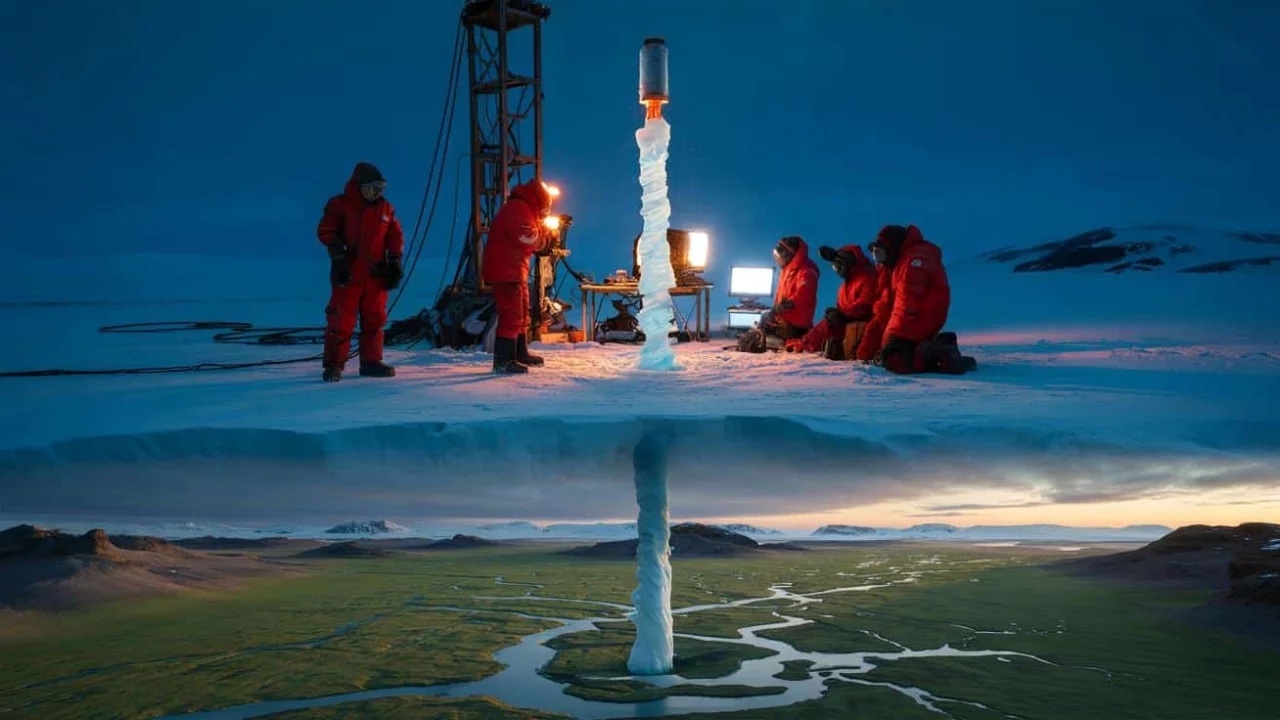
Picture this: you’re cleaning out your grandmother’s attic and you find a photo album wrapped in plastic, untouched for decades. The pictures inside are so crisp and clear they could have been taken yesterday. Now imagine that album is actually an entire landscape, and instead of decades, it’s been perfectly preserved for 34 million years.
That’s exactly what happened when scientists drilling through Antarctic ice made one of the most remarkable discoveries in recent memory. Two kilometers beneath their feet, they found something that shouldn’t exist: a complete, untouched world from a time when Earth was unrecognizably different.
This Antarctic ice discovery is rewriting everything we thought we knew about how landscapes survive under glaciers. And it’s making us question what other secrets might be hiding beneath the world’s frozen places.
What lies beneath the endless ice
The drilling team knew they were onto something when their equipment hit that telltale change in resistance. But nothing prepared them for what the ice-penetrating radar revealed next. Instead of the chaotic, ground-up mess you’d expect after millions of years of glacial grinding, they found something almost impossibly pristine.
“We were looking at valleys and hills that looked like they could have been carved yesterday,” explains Dr. Sarah Chen, a glaciologist who worked on the project. “The preservation was so perfect it gave us chills.”
The landscape they uncovered spans an area roughly the size of Belgium, tucked away beneath the East Antarctic Ice Sheet. Rivers once flowed through these valleys. Plants grew on these hills. Animals walked these paths when the world was 6 degrees warmer and Antarctica was green.
What makes this discovery extraordinary isn’t just its age. It’s how completely intact everything remains. Most ancient landscapes get pulverized by the weight and movement of ice over time. This one somehow escaped that fate, preserved like a fly in amber.
The science behind a 34-million-year time capsule
Here’s where the Antarctic ice discovery gets really fascinating. The research team used a combination of cutting-edge technology to peer through all that ice:
- Ice-penetrating radar: Radio waves that bounce off the bedrock below
- Satellite imagery analysis: Mapping subtle changes in ice surface elevation
- Computer modeling: Recreating how the landscape formed and survived
- Ice core analysis: Reading the chemical story locked in frozen layers
The key to this landscape’s survival seems to be its location and the behavior of the ice above it. Unlike glaciers that flow and grind, this section of the ice sheet has remained relatively stable, acting more like a protective blanket than a destructive force.
| Discovery Facts | Details |
|---|---|
| Depth below ice | 2 kilometers (1.24 miles) |
| Age of landscape | 34 million years |
| Size of area | Approximately 32,000 square kilometers |
| Ice sheet location | East Antarctic Ice Sheet |
| Discovery method | Ice-penetrating radar and drilling |
| Preservation quality | Nearly pristine river valleys and hills |
“The ice has been this landscape’s guardian angel,” notes Professor Mike Roberts from Durham University. “Instead of destroying it, the ice sheet has kept it in a state of suspended animation.”
The team found evidence of ancient river systems, complete with tributaries and drainage patterns that still make perfect geological sense today. Some valleys show signs of having been carved by flowing water, while elevated areas suggest they were once hilltops or ridges in a temperate climate.
Why this changes everything we know about Earth’s past
This Antarctic ice discovery isn’t just cool science—it’s a window into a version of Earth that existed when our planet was dramatically warmer. Thirty-four million years ago, during the Eocene epoch, global temperatures were about 6 degrees Celsius higher than today. There were no permanent ice sheets anywhere on Earth.
Antarctica wasn’t the frozen wasteland we know today. It was green, forested, and full of life. Rivers flowed year-round. The landscape that scientists just discovered was shaped during this warmer period, then slowly buried and preserved as the planet cooled and ice began to form.
For climate scientists, this discovery is like finding a perfect fossil of Earth’s climate future. If global warming continues at current rates, we might be heading back toward conditions similar to those that created this buried landscape.
“This gives us a snapshot of what Antarctica looked like in a much warmer world,” explains Dr. Emma Thompson, a paleoclimatologist studying the findings. “It’s both beautiful and sobering when you think about current climate trends.”
The discovery also has implications for understanding ice sheet stability. If this landscape survived 34 million years of ice coverage, what does that tell us about how ice sheets form, move, and potentially collapse? These questions become critically important as we try to predict sea level rise in our warming world.
The research team is now planning more detailed studies of the preserved landscape. They want to collect rock samples from the ancient riverbeds and analyze any organic material that might have survived the freeze. Each sample could contain clues about plants, animals, and climate conditions from this alien version of Earth.
Future expeditions will use even more sophisticated drilling techniques to explore different parts of the buried landscape. Scientists suspect there may be other preserved worlds hidden beneath Antarctica’s ice, waiting for their turn to tell Earth’s ancient stories.
This remarkable Antarctic ice discovery reminds us that our planet is full of surprises, even in places we think we know well. Beneath the ice that seems so permanent and unchanging, entire worlds wait in frozen silence, preserving secrets from times when Earth was almost unrecognizably different from the planet we call home today.
FAQs
How did scientists discover this landscape beneath the ice?
They used ice-penetrating radar and drilling equipment to map and explore the area two kilometers below the surface of the Antarctic ice sheet.
Why is this 34-million-year-old landscape so well preserved?
The ice sheet above it remained relatively stable over millions of years, acting like a protective blanket rather than grinding and destroying the landscape below.
What was Antarctica like 34 million years ago?
It was much warmer, with flowing rivers, forests, and no permanent ice coverage—global temperatures were about 6 degrees Celsius higher than today.
How large is the discovered landscape?
The preserved area covers approximately 32,000 square kilometers, roughly the size of Belgium.
What does this discovery mean for understanding climate change?
It provides insights into what Earth looked like during much warmer periods and helps scientists understand ice sheet behavior and stability.
Are there other preserved landscapes under Antarctic ice?
Scientists suspect there may be additional ancient landscapes waiting to be discovered beneath different parts of Antarctica’s ice sheets.











Leave a Comment