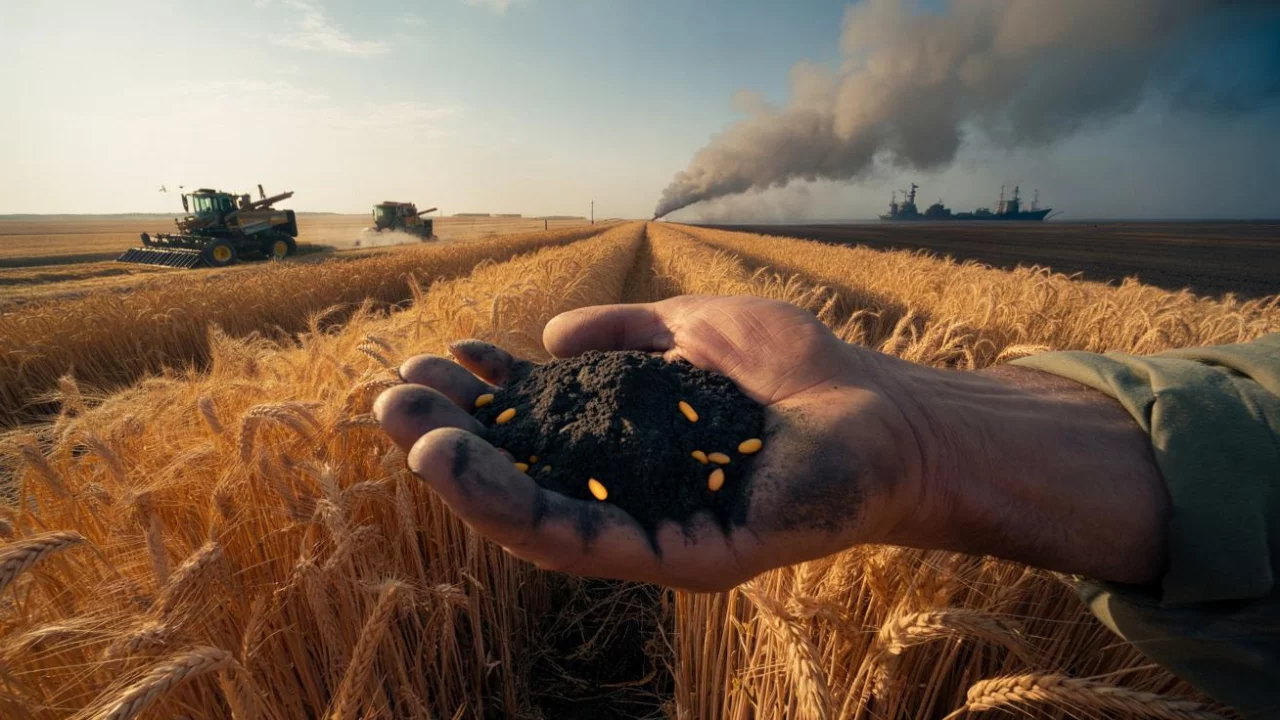
Maria clutches her phone in a small bakery in Cairo, watching the price of bread flour tick upward on her supplier’s app. Three thousand miles away, explosions echo across Ukrainian wheat fields where her family’s daily bread begins its journey. She doesn’t know about soil chemistry or export quotas. She just knows that her customers are already asking why their morning pita costs more this week than last.
This is the hidden story of the black earth belt – a ribbon of dark, fertile soil stretching from Ukraine through Russia to Kazakhstan that has quietly become one of the world’s most dangerous places. Not because of nuclear weapons or oil reserves, but because of dirt. Really, really good dirt.
What makes this soil so special also makes it so strategic. And what makes it strategic has turned it into a battlefield that affects grocery stores from Lagos to London.
Why This ‘Black Gold’ Feeds Half the World
Stand in the middle of a chornozem field in summer and you’ll understand why empires have fought over this land for centuries. The soil is so dark it looks wet even when bone dry. Grasshoppers crackle in the heat, and wheat heads sway like a golden ocean stretching to the horizon.
This is the legendary black earth belt – a crooked arc of some of the most fertile land on Earth. For centuries, it was just distant steppe with brutal winters and cheap grain. Then globalization changed everything.
“When I first started trading agricultural commodities in the 1990s, these regions were footnotes in our reports,” explains former grain trader David Morrison. “Now they’re the whole story. A single weather event in Kazakhstan can move wheat prices in Chicago.”
The numbers tell the tale. Before Russia’s full-scale invasion of Ukraine in 2022, these three countries supplied roughly one-third of global wheat exports. Ukraine alone fed tens of millions through its corn, sunflower oil, and wheat shipped across the Black Sea. Russia dominated Middle Eastern and North African markets with aggressive pricing. Kazakhstan quietly became Central Asia’s granary.
Then war turned grain into a weapon. Ports shut down, insurance companies panicked, and shipping routes became negotiating tools. A conflict that started in Eastern European soil rippled across continents in weeks.
The Science Behind the Strategic Gold Mine
What makes chornozem so valuable isn’t just its color – it’s its chemistry. This soil is loaded with humus, deep and spongy, storing water and nutrients like a massive natural battery. Even when weather turns nasty, yields stay relatively stable.
Combine that natural advantage with vast, flat landscapes perfect for industrial-scale farming, and you get some of the most efficient grain production on the planet.
| Country | Share of Global Wheat Exports (2021) | Primary Markets |
|---|---|---|
| Russia | 20% | Middle East, North Africa |
| Ukraine | 10% | Asia, EU, North Africa |
| Kazakhstan | 4% | Central Asia, China |
The strategic importance became clear when these exports suddenly stopped. Countries that had grown dependent on cheap grain from the black earth belt found themselves scrambling for alternatives:
- Egypt, where bread subsidies are politically crucial, had to find new suppliers overnight
- Lebanon saw flatbread prices jump as wheat shortages hit local bakeries
- Somalia and other East African nations faced food crisis as shipping routes closed
- Turkey became a key transit point for alternative grain corridors
“We always knew food was political, but 2022 showed us just how weaponized agriculture could become,” notes agricultural economist Dr. Sarah Chen. “When you control the world’s breadbasket, you control more than just grain prices.”
When Tractors Become Targets
The reality on the ground reveals just how fragile this global food system really is. Ukrainian farmers now run tractors without headlights to avoid being spotted by drones. Some fields are littered with unexploded shells. Harvest crews negotiate with local military commanders just to cross roads that used to be simple dirt tracks.
Every loaded grain truck has become both food and a potential military target. The same soil that feeds millions has become a battlefield where the next harvest might determine not just crop yields, but international alliances.
Russia has weaponized grain exports, using food shipments as diplomatic leverage. The country has restricted fertilizer exports, driving up farming costs globally. Meanwhile, Kazakhstan finds itself caught in the middle, trying to maintain agricultural exports while navigating complex geopolitical pressures.
“I’ve been farming this land for thirty years, and I never thought I’d see tractors painted with ‘CHILDREN’ to avoid being bombed,” says Ukrainian farmer Pavel Kovalenko. “But here we are, trying to feed the world while dodging missiles.”
The ripple effects extend far beyond the immediate war zone. Global fertilizer shortages, driven partly by sanctions on Russian and Belarusian producers, have increased farming costs worldwide. Shipping insurance rates for Black Sea routes remain elevated. Alternative grain corridors through Poland and Romania are straining under capacity limits.
Perhaps most troubling is how this crisis has exposed the vulnerability of global food security. Countries across Africa and the Middle East that relied heavily on black earth belt imports are now diversifying suppliers, but at higher costs that ultimately hit the world’s poorest consumers hardest.
The black earth belt remains as fertile as ever. The soil still holds the same natural advantages that made it a global breadbasket. But the geopolitical landscape above that soil has fundamentally changed, turning agricultural abundance into a strategic liability.
“The same characteristics that made this region feed the world – vast scale, efficient production, strategic location – also made it a natural target,” explains geopolitical analyst Mark Stevens. “Geography is destiny, but sometimes that destiny is complicated.”
As conflicts continue and climate change adds new pressures, the black earth belt’s role as both blessing and battleground will likely intensify. The soil that once quietly fed millions has become a loud reminder that in our interconnected world, every grain of wheat carries geopolitical weight.
FAQs
What exactly is the black earth belt?
It’s a region of extremely fertile dark soil (chornozem) stretching from eastern Ukraine through southern Russia to northern Kazakhstan, known for producing about one-third of the world’s wheat exports.
Why is this soil so much better than regular farmland?
Black earth is rich in humus and organic matter, making it incredibly fertile and able to store water and nutrients effectively, leading to consistent high crop yields even in difficult weather.
How has the Ukraine war affected global food prices?
The conflict disrupted grain exports from the region, causing wheat prices to spike globally and leading to bread price increases in countries across Africa and the Middle East that depend on these imports.
Which countries are most affected by grain shortages from this region?
Egypt, Lebanon, Somalia, and other North African and Middle Eastern nations that heavily relied on cheap wheat imports from Ukraine and Russia have been most impacted.
Can other countries replace these grain exports?
While countries like Argentina, Australia, and Canada are increasing production, replacing the scale and low cost of black earth belt grain exports is extremely difficult and expensive.
Is Kazakhstan still able to export grain normally?
Kazakhstan continues exporting but faces challenges with shipping routes and geopolitical pressures, plus increased global demand as buyers seek alternatives to Ukrainian and Russian grain.






Leave a Comment