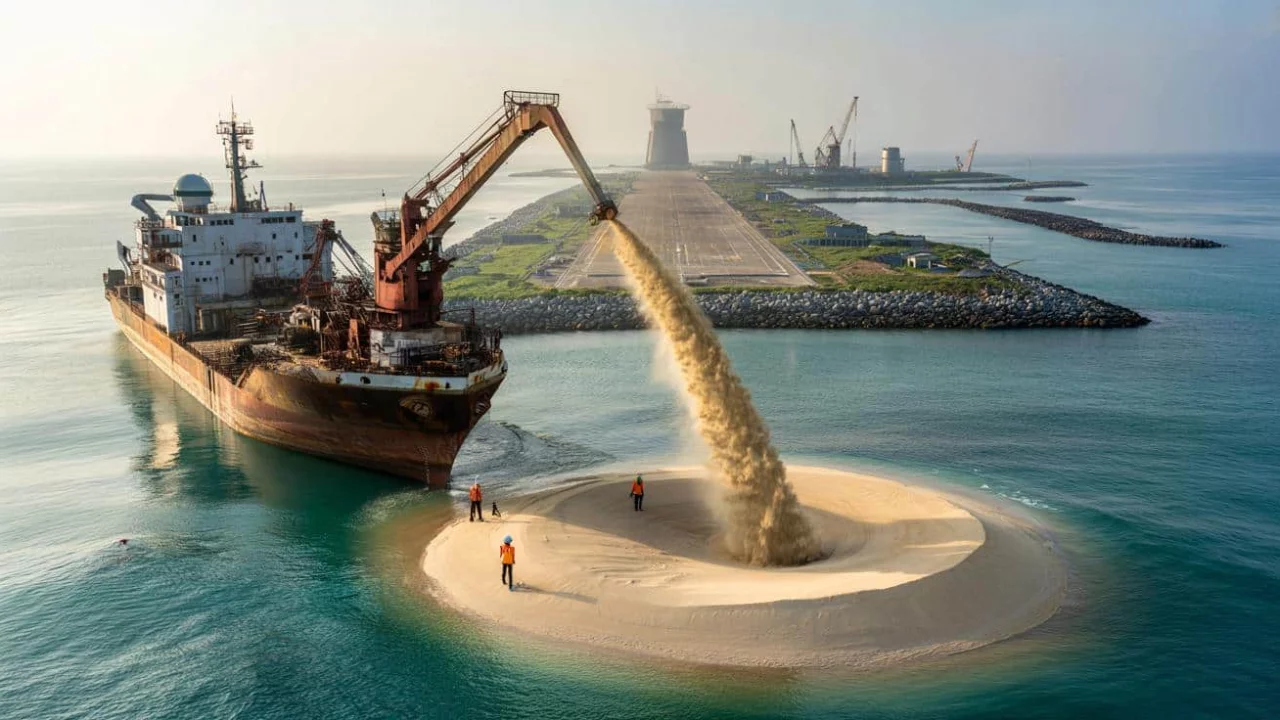
Captain Liu remembers when his grandfather used to fish these waters. Back then, you could spot the old coral reefs from miles away—just tiny dots breaking the surface during low tide. “My grandfather would anchor near Mischief Reef to wait out storms,” Liu tells me over coffee at a Manila port. “Now when I sail through that area, there’s a whole island there. With buildings. And runways.” He shakes his head, still processing what he’s witnessed. “In my lifetime, I’ve watched the ocean turn into land.”
Liu’s story isn’t unique. Fishermen, sailors, and pilots across Southeast Asia have watched something unprecedented unfold over the past twelve years. China’s artificial islands project has literally redrawn the map of the South China Sea, transforming underwater reefs into full-fledged military and civilian outposts.
What started as small-scale land reclamation has become one of the most ambitious engineering projects in modern history. And it’s changing everything about how we think about borders, sovereignty, and the permanence of geography itself.
How China Built Islands From Nothing
The scale of China’s island-building operation is staggering. Since 2013, Chinese dredging vessels have moved an estimated 13 billion tons of sand and coral to create over 3,200 acres of new land across seven major reef systems in the South China Sea.
“We’re talking about moving enough material to fill the Empire State Building about 2,000 times over,” explains Dr. Sarah Chen, a marine engineer who has studied the project. “No country has ever attempted artificial island construction at this scale or speed.”
The process looks deceptively simple from satellite images. Massive dredging ships—some longer than football fields—vacuum sand from the seafloor and spray it onto coral reefs through giant pipes. Layer by layer, the reefs disappear under mountains of sediment until they emerge as dry land.
But the engineering challenges are immense:
- Coral reefs provide unstable foundations that require massive amounts of fill material
- Ocean currents constantly try to wash away the new sand
- Tropical storms can destroy months of work in a single night
- The artificial islands must be built high enough to withstand rising sea levels
- Fresh water systems need to be created from scratch
The Chinese have solved these problems through sheer persistence and resources. They’ve deployed fleets of specialized dredging vessels, including the massive “Tian Kun Hao”—a ship capable of dredging 6,000 cubic meters of material per hour.
The New Geography of Power
China’s artificial islands aren’t just impressive engineering projects—they’re strategic game-changers. Each new island extends China’s territorial claims and military reach deep into the South China Sea, one of the world’s busiest shipping lanes.
| Island Name | Size (Acres) | Key Features | Strategic Importance |
|---|---|---|---|
| Fiery Cross Reef | 677 | 3,000m airstrip, port | Controls Spratly shipping lanes |
| Mischief Reef | 558 | 2,600m airstrip, radar | Extends air coverage south |
| Subi Reef | 976 | 3,000m airstrip, harbor | Naval base for submarines |
| Johnson South Reef | 27 | Lighthouse, helipad | Early warning system |
“These aren’t just islands—they’re unsinkable aircraft carriers,” notes Admiral James Rodriguez, a naval strategy expert. “China has essentially created a string of military bases in international waters, and there’s no easy way to remove them.”
The artificial islands give China several strategic advantages. Military aircraft based on the islands can patrol vast areas of the South China Sea. Naval vessels can refuel and resupply without returning to mainland ports. Most importantly, the islands create “facts on the ground” that strengthen China’s territorial claims.
“International law is complicated when it comes to artificial islands,” explains Professor Maria Santos, who specializes in maritime law. “China argues these installations give them extended territorial waters, while other countries say artificial islands don’t qualify for the same rights as natural land.”
What This Means for Everyone Else
The ripple effects of China’s artificial islands extend far beyond the South China Sea. For neighboring countries like Vietnam, Philippines, and Malaysia, the new geography represents a fundamental shift in regional power.
Fishing communities have been hit hardest. Traditional fishing grounds that families worked for generations are now off-limits military zones. “My father fished near Scarborough Shoal for forty years,” says Maria Santos, a fisherwoman from the Philippines. “Now Chinese coast guard ships chase us away if we get too close.”
Commercial shipping faces new uncertainties too. About $3.4 trillion in global trade passes through the South China Sea annually, and China’s expanded presence gives it more control over these vital sea lanes.
Environmental consequences are equally serious:
- Coral reef destruction has eliminated habitats for thousands of marine species
- Sediment clouds from dredging have damaged surrounding ecosystems
- Changed ocean currents affect fish migration patterns
- Pollution from construction activities has contaminated local waters
“We’ve essentially sacrificed some of the world’s most biodiverse coral reefs to create military outposts,” warns Dr. James Liu, a marine biologist. “The ecological damage will take decades to fully understand.”
Other countries haven’t stood idle. The United States has increased naval patrols through the region, conducting “freedom of navigation” operations that challenge China’s expanded claims. Regional powers are building up their own naval capabilities and forming new security partnerships.
But the fundamental reality remains: China’s artificial islands have permanently altered the strategic balance in one of the world’s most important waterways. What took nature millions of years to create, human engineering has reshaped in just over a decade.
For Captain Liu and countless others who work these waters, the transformation represents something unprecedented in human history. “My grandfather’s charts are useless now,” he says. “The ocean my family knew for generations is gone. In its place is something entirely new.”
FAQs
How long did it take China to build these artificial islands?
The major construction phase lasted from 2013 to 2016, though some work continues today. Most islands were built within 2-3 years each.
Are China’s artificial islands legal under international law?
This remains highly disputed. China claims the islands strengthen their territorial rights, while other countries argue artificial islands don’t qualify for the same legal status as natural land.
How much did the artificial island project cost?
China hasn’t released official figures, but experts estimate the total cost at several billion dollars, including the specialized dredging equipment and ongoing maintenance.
Can other countries build their own artificial islands in response?
Technically yes, but the scale and cost of China’s project would be extremely difficult for smaller nations to match. Some countries are exploring smaller land reclamation projects.
What happens to the artificial islands during typhoons?
The islands are built to withstand major storms, but they still face regular damage from typhoons and need constant maintenance to prevent erosion.
Do people actually live on these artificial islands?
The islands house military personnel, construction workers, and some civilian administrators, but they’re not designed as permanent residential communities.











Leave a Comment