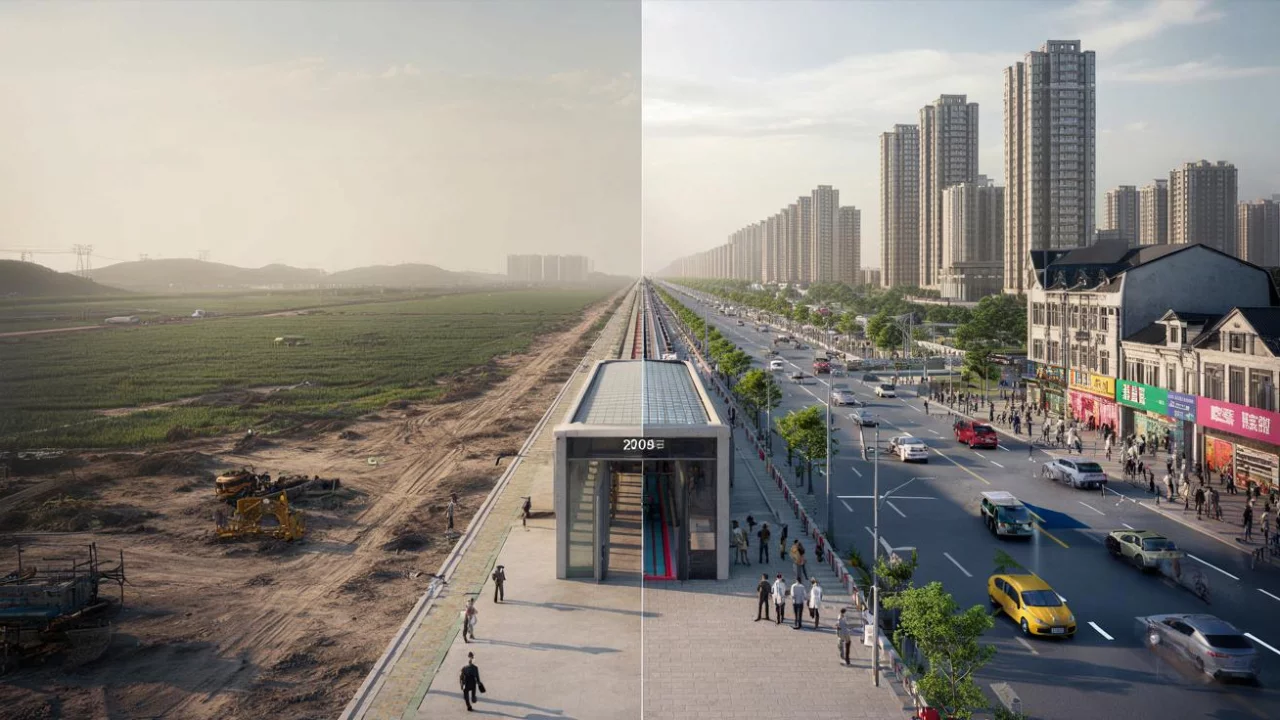
When photographer Li Wei visited Caojiawan metro station in 2015, he couldn’t stop laughing. Three pristine escalators jutted up from an empty field like alien monuments, their glass canopies gleaming under the autumn sun. No roads. No buildings. Just grass and the occasional confused passenger stepping off the train into what looked like rural China.
Li snapped photos that would go viral worldwide. “Station to nowhere,” the headlines read. “China’s infrastructure madness reaches new heights.” The images became a symbol of everything supposedly wrong with China’s building boom – wasteful, reckless, disconnected from reality.
But Li returned to Caojiawan last year. The same escalators now rise through a bustling commercial district. Apartment towers stretch toward the horizon. Coffee shops, banks, and shopping centers hum with activity. The “ghost station” has become the beating heart of a brand-new neighborhood.
The Long Game That Western Cities Couldn’t See
China ghost metro stations tell a story that challenges everything we thought we knew about urban planning. Since 2008, Chinese cities have built subway systems that seemed to defy logic – stations in empty fields, tunnels under farmland, platforms serving populations that didn’t yet exist.
The Western world watched with a mixture of fascination and horror. How could any rational government build mass transit for ghost towns?
But China wasn’t building for today. It was building for 2025, 2030, and beyond.
“We completely misunderstood the timeline,” says urban planner Dr. Sarah Chen, who has studied Chinese infrastructure projects for over a decade. “Western cities build transit to serve existing demand. China builds transit to create future demand.”
The strategy flips conventional wisdom on its head. Instead of waiting for neighborhoods to justify a metro line, China lays the infrastructure first and lets the city grow around it. The 2008 Beijing Olympics marked the turning point, when the country poured $40 billion into infrastructure and sent a clear message to other cities: build now, people will follow.
How Empty Stations Transform Into Urban Gold Mines
The transformation isn’t magic – it’s economics. Studies from cities like Wuhan show that metro stations increase commercial land values within 400 meters, even when surrounded by empty lots. Developers can pre-sell apartments more easily. Land auctions fetch higher bids. Local governments, heavily dependent on land sales revenue, suddenly have cash to fund more projects.
Here’s how China’s metro-first development typically unfolds:
| Phase | Timeline | What Happens |
|---|---|---|
| Planning | Year 0-1 | Map new districts, set population targets |
| Infrastructure | Year 1-3 | Build metro lines under empty land |
| Land Sales | Year 2-4 | Auction plots at premium prices near stations |
| Development | Year 3-7 | Residential and commercial construction begins |
| Population | Year 5-10 | People move in, businesses open |
The financial logic is compelling, but it requires patience that democracies often lack. “In London or New York, politicians need results before the next election,” explains infrastructure economist Dr. Michael Zhang. “In China, local officials can plan for decades.”
Key advantages of the infrastructure-first approach include:
- Land values increase before development costs rise
- Transit systems shape growth patterns from the beginning
- Development can be planned holistically rather than piecemeal
- Environmental and social infrastructure can be integrated early
From Memes to Models: Real-World Impact
Caojiawan isn’t unique anymore. Across China, former “ghost stations” are transforming into thriving urban centers. What looked like folly in 2015 appears prescient in 2025.
The implications stretch far beyond China’s borders. Cities worldwide are grappling with housing shortages, traffic congestion, and urban sprawl. The Chinese model offers a controversial alternative: build the bones first, let the body follow.
“We’re seeing interest from cities in Southeast Asia, Africa, and even some European planners,” notes transport consultant Dr. Elena Rodriguez. “The question isn’t whether China’s approach works – clearly it does. The question is whether other political systems can sustain that kind of long-term thinking.”
The human impact has been profound. Millions of Chinese families now live in neighborhoods that literally didn’t exist fifteen years ago. Young professionals buy apartments near metro lines that seemed absurd when construction began. Children attend schools in districts that were farmland when their parents were born.
Visited Caojiawan station today – the former "ghost station" now serves 40,000+ daily passengers. The transformation is incredible. What we called wasteful infrastructure in 2015 is now a model other cities want to copy. #UrbanPlanning
— Urban China Today (@UrbanChinaNews) January 15, 2024
But success stories don’t erase legitimate concerns. Some China ghost metro stations remain underutilized years after opening. Local governments have accumulated massive debts financing these projects. Environmental costs of rapid construction have been significant.
“Not every ghost station becomes Caojiawan,” admits Dr. Chen. “Some remain ghosts. The challenge is distinguishing between visionary planning and genuine overbuilding.”
The global conversation about urban development is shifting. Climate change demands denser, more transit-oriented cities. Housing crises require large-scale solutions. Perhaps the Chinese approach – however alien to Western sensibilities – offers lessons worth considering.
As we navigate 2025, those empty escalators rising from grass fields look less like monuments to excess and more like time machines from a future that’s already here.
FAQs
What are China ghost metro stations?
They’re subway stations built in undeveloped areas that initially served very few passengers, appearing to be “stations to nowhere” until surrounding development caught up.
Why did China build metro stations in empty areas?
To trigger urban development by increasing land values and attracting investment before population growth, reversing the typical Western approach of building transit after demand exists.
Did the ghost stations strategy actually work?
Many did work – stations like Caojiawan transformed from internet memes into busy transit hubs serving thriving new districts within 5-10 years.
How much did China spend on these infrastructure projects?
Around $40 billion was invested in infrastructure following the 2008 Beijing Olympics, with subway networks expanding rapidly across dozens of metropolitan areas.
Can other countries copy China’s approach?
It’s challenging because the strategy requires long-term political commitment and significant upfront investment that democratic governments often struggle to sustain through election cycles.
Are there any failed ghost stations?
Yes, not all ghost stations succeeded in attracting development, and some local governments accumulated substantial debt financing these projects with mixed results.











Leave a Comment