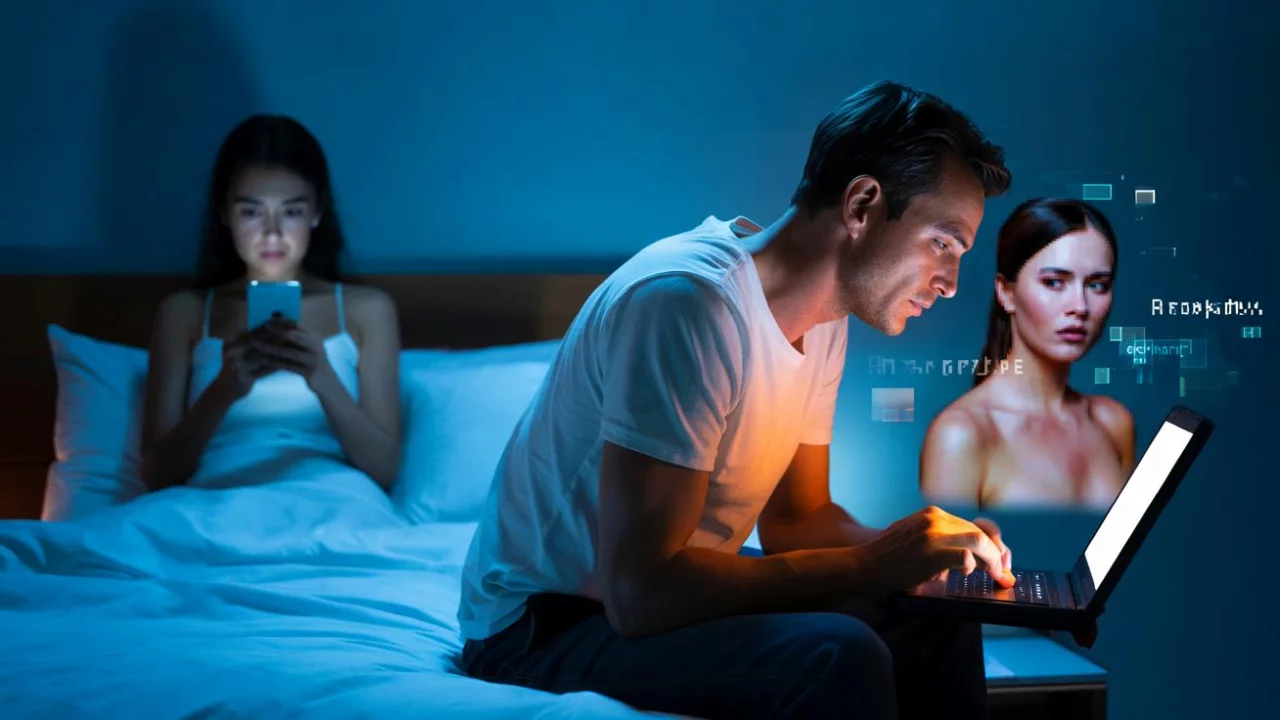
The confession dropped between two forkfuls of pasta, as if it were nothing. “It’s not cheating if it’s only pixels,” he said, shrugging, eyes still on his phone.
Across the table, her smile stopped but her body didn’t. She kept chewing, kept breathing, kept pretending the room hadn’t shrunk by half. Only pixels. As if the hours he spent in front of his screen at night were just another game. As if the naked version of her friend’s face, stitched onto a stranger’s body, wasn’t a violation with her name written all over it.
She wanted to ask what else had been “only pixels.” Instead, she just asked for the bill. That sentence stayed stuck in her head for weeks. Just pixels. Just a fantasy. Just a lie big enough to bend reality.
When Virtual Intimacy Crosses the Line
Deepfakes entered our lives like a meme – funny, clumsy, shared between friends. Faces swapped on movie scenes, politicians badly lip-synced into ridiculous speeches. But then the technology got sharper. Smoother. More convincing.
Suddenly, a bored partner with a laptop could download software, grab a few selfies from Instagram, and create hyper-realistic fake nudes in a night. Deepfaking virtual intimacy has become the new frontier of digital betrayal, where consent doesn’t exist and boundaries dissolve into pixels.
“We’re seeing a massive shift in how people justify intimate behavior online,” says Dr. Sarah Chen, a relationship therapist specializing in digital infidelity. “The ‘it’s just pixels’ defense is becoming the new ‘we were just talking’ – a way to minimize harm that feels very real to everyone else involved.”
The numbers tell a disturbing story. Recent surveys show that 1 in 4 men under 35 have engaged with deepfaked intimate content featuring someone they know personally. Most don’t consider it cheating. Their partners disagree.
What makes deepfaking virtual intimacy particularly devastating isn’t just the creation – it’s the consumption. People are using AI to generate explicit content of friends, coworkers, ex-partners, even their current partner’s friends. The technology has made fantasy indistinguishable from reality, except the consequences are entirely real.
The Shocking Reality Behind Digital Betrayal
The tools for creating deepfaked intimate content have become disturbingly accessible. Here’s what’s actually happening behind closed doors:
- Free apps can generate convincing fake nudes using just 5-10 photos from social media
- Processing time has dropped from hours to minutes on standard home computers
- Quality has improved to the point where casual observers can’t detect fakes
- Underground communities share techniques and target-specific content requests
- Mobile apps disguised as photo editors contain deepfake generation tools
The psychological impact extends far beyond the immediate relationship. “When someone discovers their partner has been creating or consuming deepfaked content of people they both know, it shatters multiple layers of trust,” explains Dr. Michael Rodriguez, a digital ethics researcher. “It’s not just about sexual boundaries – it’s about consent, privacy, and what’s real anymore.”
| Type of Deepfaked Content | Reported Usage | Relationship Impact |
|---|---|---|
| Known acquaintances | 67% | High betrayal trauma |
| Partner’s friends | 43% | Severe trust breakdown |
| Ex-partners | 38% | Emotional affair territory |
| Celebrities/strangers | 89% | Moderate concern |
The “pixels” defense falls apart when you consider the preparation involved. This isn’t passive consumption of random content – it requires deliberate effort to source photos, learn software, and spend time crafting specific scenarios. The emotional investment is undeniable.
Women are particularly affected as both victims of non-consensual deepfakes and as partners discovering their boyfriend’s or husband’s virtual betrayals. “The violation is twofold,” notes cybersecurity expert Lisa Park. “Their images are stolen and manipulated without consent, while their relationships are damaged by partners who refuse to acknowledge the harm.”
The Devastating Impact on Real Relationships
The fallout from deepfaking virtual intimacy creates a unique form of relationship trauma. Unlike traditional infidelity, there’s no physical contact, no emotional connection with another person – just the cold calculation of digital manipulation. Yet the betrayal cuts deeper in some ways.
Partners discovering deepfaked content report feeling violated not just sexually, but intellectually. Their loved one chose to invest time and energy creating fake intimate scenarios rather than addressing real relationship needs. The premeditation feels more calculated than a moment of weakness.
Sarah, whose husband created deepfaked content of her sister, describes the discovery: “Finding those files felt like walking into a nightmare I couldn’t wake up from. It wasn’t just the images – it was knowing he’d looked at my sister’s vacation photos and thought about her that way. Every family dinner since then feels contaminated.”
The legal landscape remains murky. While some states have criminalized non-consensual deepfakes, enforcement is inconsistent and often requires proof that images were shared publicly. Private creation and consumption exist in a legal gray area, leaving victims with few options for recourse.
Mental health professionals are seeing new patterns of trauma. “Traditional infidelity counseling doesn’t quite fit,” explains therapist Dr. Amanda Foster. “Partners struggle with questions like: ‘If no real person was involved, why does this hurt so much?’ The answer is that violation of trust doesn’t require a physical affair – digital betrayal can be just as damaging.”
Recovery becomes complicated when the perpetrator genuinely believes “it’s just pixels” constitutes a valid defense. Without acknowledgment of harm, rebuilding trust becomes nearly impossible. Many relationships don’t survive the revelation, not because of the sexual content itself, but because of the fundamental disagreement about what constitutes betrayal in the digital age.
Perhaps most troubling is how deepfaking virtual intimacy normalizes non-consensual sexualization. When partners defend creating fake nudes by claiming the target “won’t know” or “won’t be hurt,” they reveal a disturbing disconnection from concepts of consent and human dignity.
The technology isn’t going away – it’s getting better and more accessible. What needs to change is our understanding of digital consent and the real harm caused by virtual violations. “It’s just pixels” might be technically accurate, but those pixels carry the weight of broken trust, violated consent, and relationships that may never recover.
FAQs
Is creating deepfaked intimate content of someone without their consent illegal?
Laws vary by location, but many states are criminalizing non-consensual deepfakes, especially if they’re shared publicly.
How can someone tell if intimate images of them have been deepfaked?
Detection is becoming harder, but inconsistencies in lighting, skin texture, or facial proportions can sometimes reveal fakes.
Should deepfaking someone you know be considered cheating?
Many relationship experts say yes – the time, effort, and sexual intent involved constitute a form of digital infidelity.
Can relationships recover from deepfaking betrayal?
Recovery is possible but requires the perpetrator to acknowledge the harm caused and commit to rebuilding trust through transparency.
What should someone do if they discover their partner creating deepfaked content?
Document the evidence, seek support from a counselor familiar with digital betrayal, and decide whether the relationship can continue with professional help.
Are there ways to protect personal photos from being used in deepfakes?
Limiting public social media photos and using privacy settings can help, but determined individuals can still access images through mutual connections.











Leave a Comment