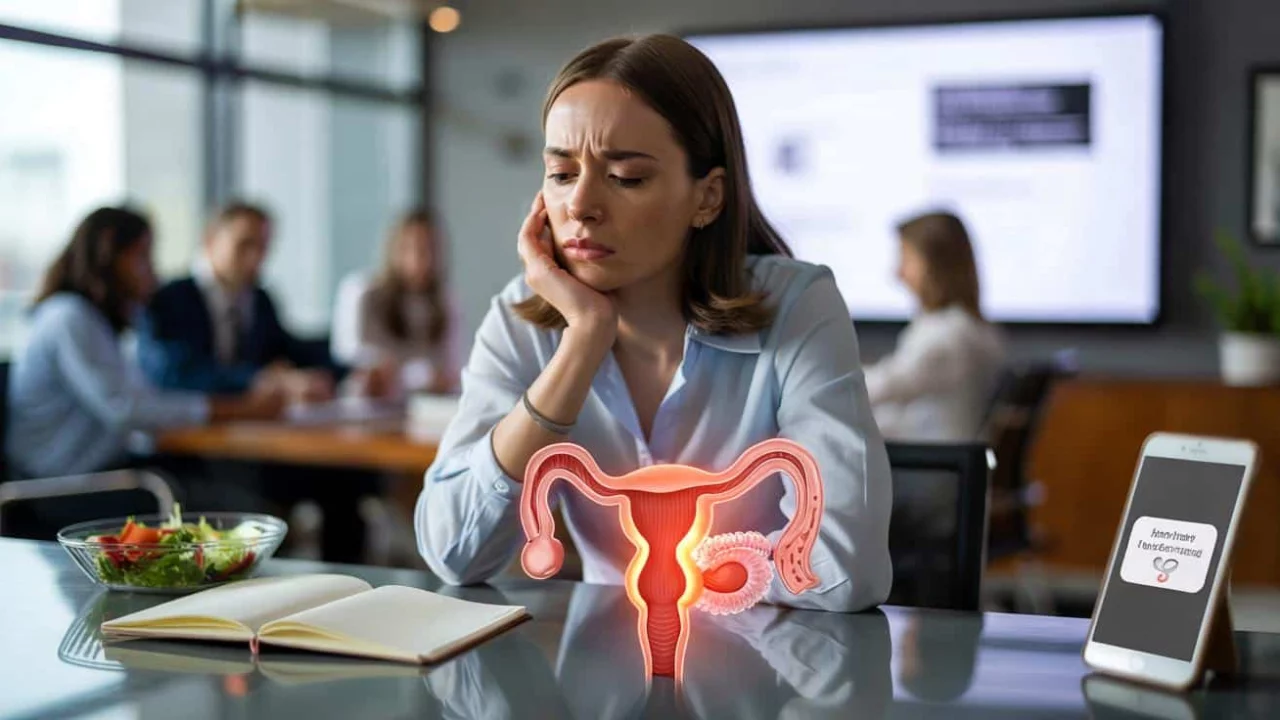
The meeting had barely started and Emma was already counting the minutes, one hand on her notebook, the other discreetly pressed against her lower belly. She’d eaten the same simple salad she always did at lunch. No spicy sauce, no glass of wine the night before, no giant dessert. Still, her gut felt like it was twisting slowly, as if someone had silently turned up the volume on every tiny cramp inside.
She checked her phone during a slide change and saw the period-tracking app notification: “PMS window starting.” The timing clicked instantly. Same food, same routine, totally different pain level. Something else had clearly entered the chat.
When hormones turn a simple twinge into a stabbing pain
We tend to blame the plate in front of us for every cramp, bloat, or burning sensation. Too much cheese, not enough fiber, coffee on an empty stomach. Yet the more you listen to people talk about their digestion, the more a strange pattern appears. The exact same meal can feel totally harmless one week and unbearable the next.
Something invisible is shifting the threshold between “mild discomfort” and “why does my gut hate me today.” That invisible force is your hormone cycle, and it’s running a 24/7 operation on your digestive system that most people never realize exists.
Dr. Sarah Martinez, a gastroenterologist specializing in women’s digestive health, puts it simply: “Your gut has hormone receptors just like your reproductive organs do. When estrogen and progesterone fluctuate, your intestines feel every single change.”
Take Léa, 29, who swears her body runs on a 28-day schedule, not a 24-hour one. Most days, she can handle a bowl of pasta, a yogurt, and a late dinner with only a bit of fullness. Then comes the week before her period. Suddenly, the same pasta blows her belly up like a balloon, her reflux wakes her at 3 a.m., and she walks around holding the top of her jeans.
Nothing else in her lifestyle has changed. The difference is purely hormonal, and it’s affecting millions of people who menstruate without them even knowing why their digestive pain amplifies at certain times of the month.
The science behind digestive pain hormones
What’s happening behind the scenes is a hormonal roller coaster running straight through the digestive tract. Estrogen and progesterone rise and fall, telling the muscles of the gut to slow down or speed up. They affect how sensitive the intestinal nerves are, how much water stays in the colon, even how we perceive pain signals traveling to the brain.
Here’s exactly how different hormones impact your digestive system:
- Estrogen: Increases gut sensitivity and can trigger inflammation in the intestinal lining
- Progesterone: Slows down gut motility, leading to constipation and bloating
- Prostaglandins: Cause uterine contractions but also affect bowel contractions
- Cortisol: Stress hormone that disrupts the gut-brain connection during hormonal changes
The timing of these hormonal shifts creates predictable patterns of digestive discomfort:
| Cycle Phase | Hormone Level | Common Digestive Symptoms |
|---|---|---|
| Follicular (Days 1-13) | Rising Estrogen | Improved digestion, less bloating |
| Ovulation (Day 14) | Peak Estrogen | Best digestive function |
| Luteal (Days 15-28) | High Progesterone | Bloating, constipation, cramping |
| Premenstrual (Days 25-28) | Dropping Hormones | Maximum digestive pain and sensitivity |
“During the premenstrual phase, progesterone levels crash while prostaglandins surge,” explains Dr. Jennifer Walsh, a reproductive endocrinologist. “This creates a perfect storm where the gut becomes hypersensitive while also contracting more intensely.”
The gut-brain axis plays a crucial role too. Hormonal fluctuations affect serotonin production in the intestines, which influences both mood and digestion. That’s why many people experience both emotional sensitivity and digestive pain during the same hormonal windows.
Who feels the impact most and what it means for daily life
Not everyone experiences digestive pain from hormones equally. Certain groups are more susceptible to these cyclical digestive issues:
- People with existing digestive conditions like IBS or Crohn’s disease
- Those with endometriosis, where hormonal tissue grows outside the uterus
- Individuals going through perimenopause with erratic hormone swings
- People taking hormonal birth control, which can alter natural hormone patterns
For many, this knowledge comes as a relief. Rachel, 34, spent years thinking she had developed food intolerances. “I’d eat pizza one week and feel fine, then eat the exact same pizza two weeks later and spend the night in agony,” she says. “Learning about hormonal digestive cycles finally gave me answers.”
The practical impact is significant. People adjust their work schedules around “bad digestive days,” avoid social eating during certain weeks, or unnecessarily restrict their diets thinking they’ve developed new food sensitivities.
Dr. Maria Rodriguez, a women’s health specialist, notes: “Once patients understand the hormonal connection, they can plan better. They know when to avoid trigger foods, when to schedule important meetings, and when to be gentler with their digestive system.”
Understanding this connection also helps distinguish between hormone-related digestive pain and symptoms that might indicate more serious conditions requiring medical attention. Cyclical patterns that align with menstrual cycles are typically hormonal, while constant or worsening pain regardless of cycle timing warrants further investigation.
The good news is that awareness leads to better management. Simple strategies like eating smaller meals during high-progesterone phases, staying hydrated, and gentle exercise can significantly reduce hormone-amplified digestive pain. Some people find that tracking their symptoms alongside their menstrual cycle reveals clear patterns they can work with rather than against.
For those seeking relief, working with healthcare providers who understand the hormone-gut connection can lead to targeted treatments, whether through dietary adjustments, stress management, or in some cases, hormonal therapies that smooth out the most disruptive fluctuations.
FAQs
Why does the same food cause different levels of digestive pain at different times of the month?
Hormonal fluctuations change how sensitive your gut is and how efficiently it processes food, making identical meals feel completely different depending on your cycle phase.
Can birth control help reduce hormone-related digestive pain?
Some types of hormonal birth control can smooth out hormonal fluctuations and reduce cyclical digestive symptoms, though results vary by individual.
Is it normal to have digestive issues only during PMS?
Yes, many people experience digestive symptoms exclusively during their premenstrual phase due to dropping hormone levels and increased prostaglandin production.
Do men experience hormone-related digestive changes?
Men can experience digestive changes related to testosterone fluctuations, though these patterns are less predictable than menstrual cycle-related changes.
When should I see a doctor about cyclical digestive pain?
If your symptoms are severe enough to disrupt daily activities, don’t follow a clear hormonal pattern, or worsen over time, consult a healthcare provider.
Can stress make hormone-related digestive pain worse?
Absolutely – stress increases cortisol production, which amplifies both hormonal fluctuations and gut sensitivity, creating a cycle of worsening symptoms.











Leave a Comment