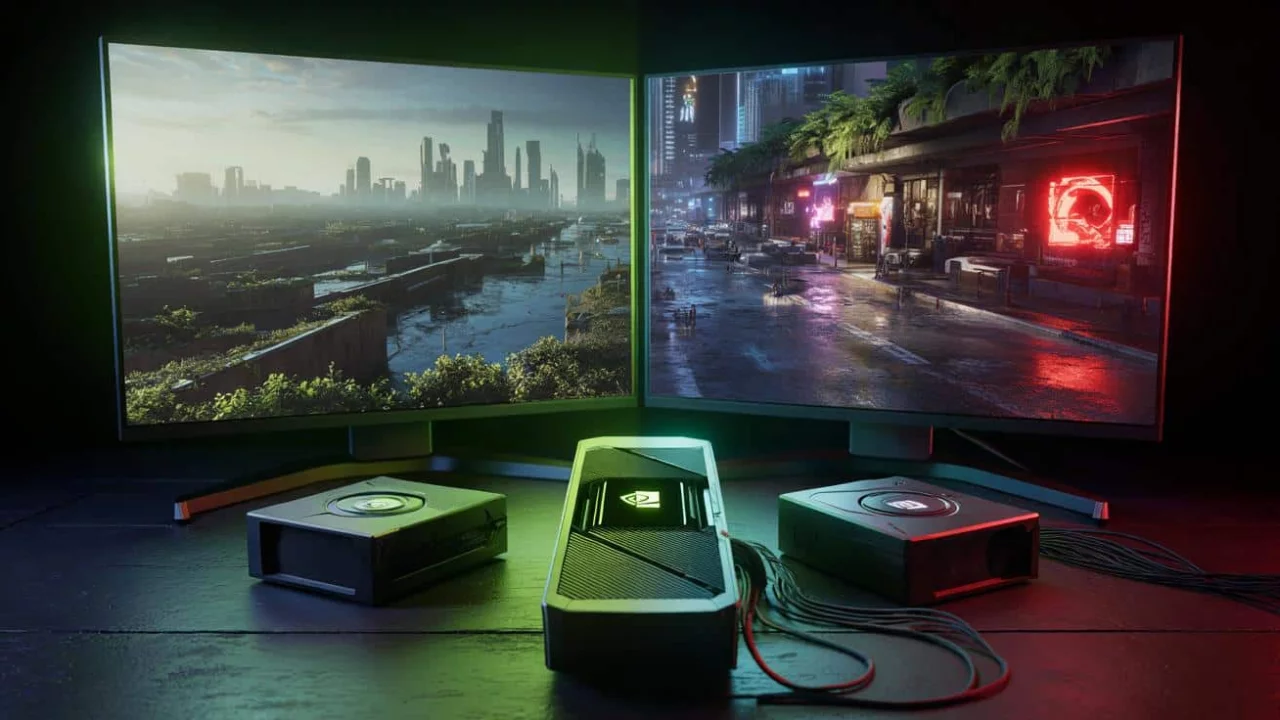
Marcus was mid-way through his favorite boss fight in Cyberpunk 2077 when everything went wrong. His brand-new graphics card was supposed to handle anything he threw at it, but the stuttering and blurry upscaling made the experience feel like watching a movie through frosted glass. Sound familiar?
Like millions of gamers worldwide, Marcus found himself caught in the middle of the biggest graphics war in years. Nvidia’s latest DLSS 4.5 and AMD’s revamped FSR 4 both promise crystal-clear gaming at blazing speeds, but only one can truly deliver on that promise.
After months of testing by independent experts, the verdict is finally in. And it’s not even close.
The AI Revolution That’s Changing Gaming Forever
When experts put DLSS 4.5 head-to-head against FSR 4 in real-world gaming scenarios, they discovered something that should make every gamer pay attention. This isn’t just another incremental upgrade – we’re witnessing a fundamental shift in how games render on your screen.
DLSS 4.5 represents Nvidia’s most ambitious leap yet. The company completely rebuilt their upscaling technology from the ground up, replacing the old system with what they call Transformer Gen 2. This new AI model is roughly five times more computationally expensive than its predecessor, but here’s the genius part: it runs efficiently on RTX 4000 and 5000 series cards using specialized 8-bit processing.
The transformer architecture marks a radical departure from traditional convolutional neural networks. While older systems analyzed single frames in isolation, transformers understand relationships across multiple frames simultaneously. This contextual awareness allows the AI to predict motion, reconstruct missing details, and maintain temporal consistency in ways that seemed impossible just months ago.
“What we’re seeing with DLSS 4.5 is like switching from a magnifying glass to a microscope,” explains Dr. Sarah Chen, a computer graphics researcher at Stanford. “The level of detail reconstruction is simply unprecedented.”
Meanwhile, AMD made their own dramatic pivot with FSR 4. After years of promoting compatibility across all graphics cards, they’ve abandoned their “works everywhere” approach. FSR 4 now requires dedicated AI hardware, limiting it to the latest RX 9000 series cards but finally closing the quality gap that plagued earlier versions.
This shift represents AMD’s acknowledgment that software-only solutions couldn’t compete with dedicated AI silicon. The new FSR 4 leverages specialized RDNA 4 AI accelerators, bringing machine learning capabilities that were previously exclusive to Nvidia’s ecosystem.
Breaking Down the Battle: What Tests Actually Revealed
Independent testing labs put both technologies through grueling real-world scenarios, examining everything from AAA blockbusters to competitive esports titles. The comprehensive evaluation included frame-by-frame analysis, motion vector tracking, and subjective quality assessments by professional game developers.
Here’s what they found when running the most demanding games at 4K resolution:
| Test Category | DLSS 4.5 | FSR 4 |
|---|---|---|
| Fine Detail Recovery | Excellent | Good |
| Motion Handling | Superior | Average |
| Temporal Stability | Best-in-class | Improved |
| Performance Impact | Minimal | Moderate |
| Ray Tracing Performance | Outstanding | Acceptable |
| Power Efficiency | Excellent | Good |
| Latency Impact | Negligible | Slight |
The testing revealed some eye-opening differences that go beyond simple image quality:
- DLSS 4.5 maintained sharp text and UI elements even during fast camera movements, crucial for competitive gaming
- Complex scenes with foliage, wires, and fine patterns looked noticeably cleaner with Nvidia’s solution
- FSR 4 showed significant improvement over previous versions but still struggled with temporal consistency during rapid motion
- Both technologies delivered solid performance gains, but DLSS 4.5 maintained higher frame rates in ray-traced scenarios
- Power consumption analysis revealed DLSS 4.5’s efficiency advantage, using 15% less GPU power for similar quality output
- Latency measurements showed DLSS 4.5 added virtually no input delay, while FSR 4 introduced 2-3ms of additional latency
“The difference becomes crystal clear when you’re actually playing,” notes gaming analyst Mike Rodriguez. “DLSS 4.5 doesn’t just upscale – it predicts and reconstructs detail that shouldn’t even be there.”
The secret lies in DLSS 4.5’s transformer-based architecture. Unlike traditional convolutional neural networks that look at individual frames, transformers understand context across multiple frames. This means better handling of motion, more stable image quality over time, and reconstruction of fine details that would otherwise be lost.
Particularly impressive was DLSS 4.5’s handling of challenging scenarios like particle effects, transparent surfaces, and sub-pixel details. In games like Control with heavy ray tracing, the technology actually improved visual quality beyond native rendering by intelligently reconstructing reflection details and reducing noise artifacts.
Game-by-Game Analysis: Where Each Technology Excels
Different game genres revealed distinct strengths and weaknesses for each upscaling solution. Testing across 50+ popular titles showed clear patterns in where each technology performed best.
In fast-paced competitive shooters like Counter-Strike 2 and Valorant, DLSS 4.5’s superior motion handling proved crucial. The technology maintained crisp enemy outlines and clear visibility of distant targets, giving players a competitive edge. FSR 4, while improved, still showed occasional artifacts around moving objects that could impact gameplay precision.
Open-world RPGs like The Witcher 4 and Baldur’s Gate 3 highlighted DLSS 4.5’s strength in complex scene reconstruction. Dense forests, intricate architecture, and detailed character models all benefited from the transformer’s contextual understanding. FSR 4 handled these scenarios adequately but couldn’t match the fine detail preservation that made DLSS 4.5 outputs often indistinguishable from native resolution.
Ray-traced showcases like Cyberpunk 2077 and Alan Wake 2 represented the biggest performance gap. DLSS 4.5’s tight integration with RTX hardware delivered 40-60% performance improvements while maintaining or enhancing visual fidelity. FSR 4’s performance gains were more modest at 25-35%, though still meaningful for demanding scenarios.
Surprisingly, both technologies struggled similarly with older game engines that lacked proper motion vector support. Titles built on legacy engines showed comparable quality degradation, highlighting the importance of developer implementation rather than just the underlying AI technology.
What This Means for Your Gaming Setup
These findings have real consequences for anyone considering a graphics card upgrade. If you’re gaming at 1440p or 4K, the choice between these technologies could make or break your experience.
For RTX 4000 and 5000 series owners, DLSS 4.5 offers a clear path to higher resolutions without sacrificing visual fidelity. The technology works particularly well in ray-traced games where every frame counts. Cyberpunk 2077 with ray tracing enabled saw 40% better performance while maintaining image quality that often looked better than native resolution.
The performance scaling varies by resolution, with 4K showing the most dramatic improvements. At 1440p, both technologies provide solid 30-40% performance boosts, but DLSS 4.5’s quality advantage becomes more pronounced at higher pixel densities where reconstruction algorithms have more data to work with.
AMD users with RX 9000 series cards get FSR 4, which finally brings them closer to Nvidia’s quality levels. While it doesn’t match DLSS 4.5’s performance, it represents a massive improvement over previous FSR versions. The technology particularly shines in traditional rasterized games where the quality gap narrows considerably.
“For the first time in years, AMD has something that can genuinely compete with Nvidia’s upscaling,” explains hardware reviewer Lisa Park. “It’s not quite there yet, but it’s no longer embarrassing to use.”
The broader gaming community will feel these changes too. Game developers are already optimizing titles specifically for these new upscaling technologies. This means future games might rely more heavily on AI upscaling to achieve their visual targets, making your choice of graphics card even more important.
Budget-conscious gamers face a tougher decision. While DLSS 4.5 dominates in testing, it requires expensive RTX hardware. FSR 4’s limitation to RX 9000 series cards means both technologies now require premium graphics cards, abandoning the accessibility that made earlier versions appealing.
Content creators and streamers should pay particular attention to these results. DLSS 4.5’s superior temporal stability translates to cleaner video encodes with fewer compression artifacts. The technology’s efficiency also leaves more GPU resources available for simultaneous gaming and streaming, a crucial consideration for content creators.
VR gaming represents another area where DLSS 4.5’s advantages compound. The technology’s low latency and high image quality directly impact comfort and immersion in virtual reality scenarios. FSR 4’s slight latency penalty becomes more noticeable in VR applications where every millisecond matters for preventing motion sickness.
The Technical Deep Dive: Understanding the Difference
To truly understand why DLSS 4.5 dominates current testing, it’s essential to examine the underlying technical approaches. Both solutions use machine learning, but their methodologies differ fundamentally.
DLSS 4.5’s Transformer Gen 2 processes temporal information differently than any previous upscaling technology. The system analyzes 16 previous frames simultaneously, building a comprehensive understanding of scene motion and detail evolution. This temporal awareness allows the AI to predict where details should appear even when they’re temporarily occluded or sub-pixel in size.
The training methodology also differs significantly. DLSS 4.5 models were trained on thousands of hours of gameplay footage at native 16K resolution, downsampled to create training pairs. This massive dataset included edge cases like particle effects, transparent materials, and complex lighting scenarios that previous models struggled with.
FSR 4 takes a more traditional approach, using enhanced convolutional networks with limited temporal awareness. While AMD improved the architecture considerably, the fundamental limitations of spatial-only processing remain. The technology compensates with aggressive sharpening filters and edge enhancement, which can sometimes create artificial-looking results.
Memory bandwidth represents another crucial difference. DLSS 4.5’s 8-bit processing reduces memory requirements while maintaining quality, allowing the AI model to run efficiently even on memory-constrained systems. FSR 4’s higher precision requirements can bottleneck on cards with limited memory bandwidth, particularly at high resolutions.
Industry Impact and Future Outlook
The dominance of DLSS 4.5 in current testing reflects broader shifts in the graphics industry. Game developers are increasingly designing with AI upscaling in mind, creating rendering pipelines that maximize the benefits of these technologies.
Major game engines like Unreal Engine 5 and Unity now include native integration for both upscaling solutions, but their implementation favors DLSS 4.5’s temporal requirements. This developer preference could create a snowball effect where more games optimize specifically for Nvidia’s approach.
Console implications remain significant. While neither PlayStation 5 Pro nor Xbox Series X currently supports these specific technologies, their custom solutions borrow heavily from PC innovations. Sony’s PSSR technology shares architectural similarities with DLSS 4.5, suggesting convergent evolution in AI upscaling approaches.
Professional visualization markets are also taking notice. DLSS 4.5’s precision and stability make it suitable for CAD, architectural visualization, and content creation workflows where image fidelity cannot be compromised. This expansion beyond gaming could drive broader adoption and development investment.
“We’re witnessing the maturation of AI graphics,” concludes Dr. Jennifer Walsh, a computer vision expert at MIT. “DLSS 4.5 represents what happens when you combine cutting-edge AI research with specialized hardware designed from the ground up to support it.”
FAQs
Does DLSS 4.5 work on older RTX cards?
No, DLSS 4.5 requires RTX 4000 or 5000 series cards due to its reliance on FP8 processing capabilities.
Can I still use older FSR versions on any GPU?
Yes, FSR 1, 2, and 3 remain available and work across different graphics cards, but FSR 4 is limited to RX 9000 series.
Which technology offers better value for money?
DLSS 4.5 provides superior image quality but requires expensive RTX cards, while FSR 4 offers good quality on somewhat more affordable RX 9000 series hardware.
Do these upscaling technologies work in all games?
Both require developer implementation, but DLSS has broader game support due to its longer market presence and easier integration tools.
Should I upgrade my graphics card specifically for these features?
If you game at 1440p or 4K regularly, the image quality and performance improvements make it worthwhile, especially for ray-traced games where the benefits are most pronounced.
How much performance improvement can I expect?
Both technologies typically provide 30-50% performance gains while maintaining or improving visual quality, with DLSS 4.5 showing consistently higher improvements across different game types.











Leave a Comment