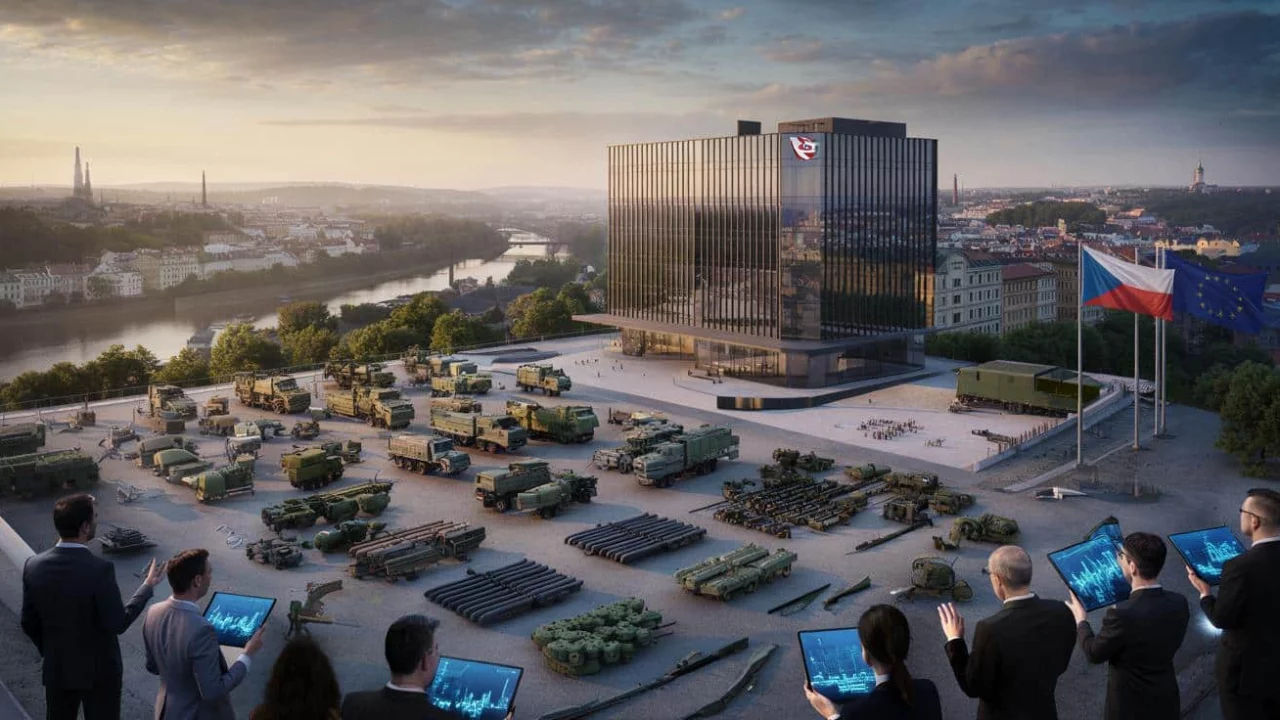
Maria Novák still remembers the day her grandfather’s old factory in Brno got a new lease on life. The ammunition plant had been shuttered since the 1990s, another casualty of post-communist transition. Then in 2019, a Prague-based company called Czechoslovak Group rolled up with cash and ambition. Today, that same facility runs three shifts, churning out artillery shells for European militaries desperate to rebuild their arsenals.
“My neighbors thought I was crazy when I said the defence industry would come back,” Maria laughs, watching trucks loaded with military equipment roll past her kitchen window. “Now they’re all asking if there are more jobs.”
Her story captures something bigger happening across Central Europe. While the world focused on traditional powerhouses like Germany’s Rheinmetall or France’s Thales, a Czech company has been quietly assembling what could become the continent’s next major defence force.
The Prague upstart reshaping European defence
Czechoslovak Group didn’t appear overnight, but most people outside defence circles had never heard of it until recently. Founded by billionaire Michal Strnad, this family-owned conglomerate spent decades buying up struggling industrial assets across Central and Eastern Europe. What looked like opportunistic bargain-hunting now appears to have been strategic genius.
The company’s timing couldn’t have been better. Russia’s invasion of Ukraine exposed Europe’s shocking lack of ammunition and military equipment. Suddenly, governments that had been cutting defence budgets for thirty years were scrambling to rebuild their capabilities.
“We’re seeing orders that would have taken five years to materialize suddenly appearing in five months,” explains defense analyst Pavel Zona from the Prague Security Studies Institute. “CSG positioned itself perfectly for this moment.”
The planned IPO represents more than just another stock listing. If successful, it would create the first major European defence giant based outside the traditional Franco-German axis. This shift could fundamentally alter how Europe thinks about its military industrial base.
By the numbers: Building a defence empire
Czechoslovak Group’s rise becomes clearer when you examine their methodical expansion strategy. The company didn’t just buy random assets – they targeted specific capabilities across the defence supply chain.
| Division | Key Assets | Annual Revenue (Est.) |
|---|---|---|
| Ammunition | STV Group, Explosia | €800 million |
| Aerospace | Aero Vodochody | €200 million |
| Land Systems | Tatra Trucks, VOP | €600 million |
| Electronics | Retia, ERA | €150 million |
The ammunition division alone produces enough shells to supply several European armies. Their Explosia plant in the Czech Republic can manufacture 155mm artillery rounds – exactly what Ukraine and NATO countries desperately need right now.
Here’s what makes CSG different from traditional European defence companies:
- Speed: While Western competitors navigate complex bureaucracies, CSG can make decisions and pivot quickly
- Cost advantage: Lower labor costs in Central Europe translate to competitive pricing
- Full spectrum: From trucks to fighter jets to electronic warfare systems
- No legacy baggage: Unlike older companies, they’re not tied to outdated platforms or political constraints
“They’re not burdened by the same political considerations that slow down companies like Airbus or Leonardo,” notes Brussels-based defence consultant Andrea Ghetti. “When a customer needs something, CSG can usually deliver faster and cheaper.”
The IPO timing also leverages Europe’s current defence spending boom. NATO members are racing to meet the 2% GDP spending target, while the EU has launched multiple defence initiatives. CSG wants to be ready when that money starts flowing.
What this means for Europe’s military future
The emergence of a new European defence giant outside the traditional Franco-German sphere could reshape continental security in several ways. Most immediately, it provides European countries with an alternative to dependence on American or Western European suppliers.
Poland, for example, has become one of CSG’s biggest customers. The company’s Tatra trucks now form the backbone of Polish artillery units, while their ammunition plants help fill Warsaw’s massive shell orders. This creates a new axis of military cooperation between Czech industry and Eastern European buyers.
“We’re seeing the creation of a Central European defence ecosystem,” explains Tomáš Valášek, former Slovak ambassador to NATO. “Countries like Poland, Czech Republic, and Slovakia are developing integrated military supply chains that don’t depend on Berlin or Paris approval.”
For ordinary Europeans, this shift could mean several things:
- Job creation: Defence manufacturing typically pays well above average industrial wages
- Economic security: Less dependence on imports for critical military equipment
- Regional development: Many CSG facilities are in smaller cities that need industrial investment
- Strategic autonomy: Europe becomes less dependent on non-EU suppliers
The company’s success also reflects broader changes in European geopolitics. The war in Ukraine has accelerated Eastern Europe’s rise as a strategic player, not just a passive recipient of Western security guarantees.
“What we’re seeing is the maturation of Central European capitalism,” says economist Jana Žitňanská from Bratislava’s Economic University. “These countries now have their own multinational companies that can compete globally.”
However, the IPO’s success isn’t guaranteed. Defence stocks can be volatile, and investors may worry about CSG’s dependence on current military tensions. If the war in Ukraine ends soon, some of the urgent demand for ammunition and equipment could evaporate.
There are also competitive challenges. Established players like BAE Systems, Lockheed Martin, and Rheinmetall won’t simply cede market share to a Czech upstart. They have deeper pockets, longer customer relationships, and more advanced technologies in some areas.
But CSG’s rapid growth suggests they’ve found a sweet spot in the market. By focusing on practical, proven technologies rather than cutting-edge innovations, they can deliver what customers actually need at prices they can afford.
As Maria Novák watches another convoy of military trucks roll through her town, she reflects on how quickly things have changed. “Five years ago, people here were worried about factory closures and young people leaving. Now we’re talking about expansion and hiring more workers.”
Her experience mirrors a broader transformation. Central Europe is no longer just a source of cheap labor or a market for Western products. Companies like Czechoslovak Group represent the emergence of indigenous European champions that can compete on the global stage.
Whether this new European defence giant can maintain its momentum after going public remains to be seen. But one thing is clear: the old assumptions about where military power gets built in Europe are rapidly becoming obsolete.
FAQs
What exactly is Czechoslovak Group?
It’s a Czech industrial conglomerate that owns dozens of companies making everything from military trucks to fighter jets and ammunition.
Why is their IPO significant for Europe?
It would create the first major European defence company based outside Germany and France, potentially reshaping the continent’s military industrial landscape.
How big is Czechoslovak Group compared to other defence companies?
While smaller than giants like BAE Systems or Lockheed Martin, CSG is rapidly approaching the size of mid-tier European players like Leonardo or Saab.
What products do they actually make?
Their portfolio includes artillery shells, military vehicles, aircraft, radar systems, and electronic warfare equipment.
Will this affect NATO or EU defence cooperation?
Potentially yes – it creates new supply chains within Europe and reduces dependence on American suppliers for some types of equipment.
When will the IPO happen?
The company is preparing for a potential listing in 2024, though exact timing depends on market conditions and regulatory approval.











Leave a Comment