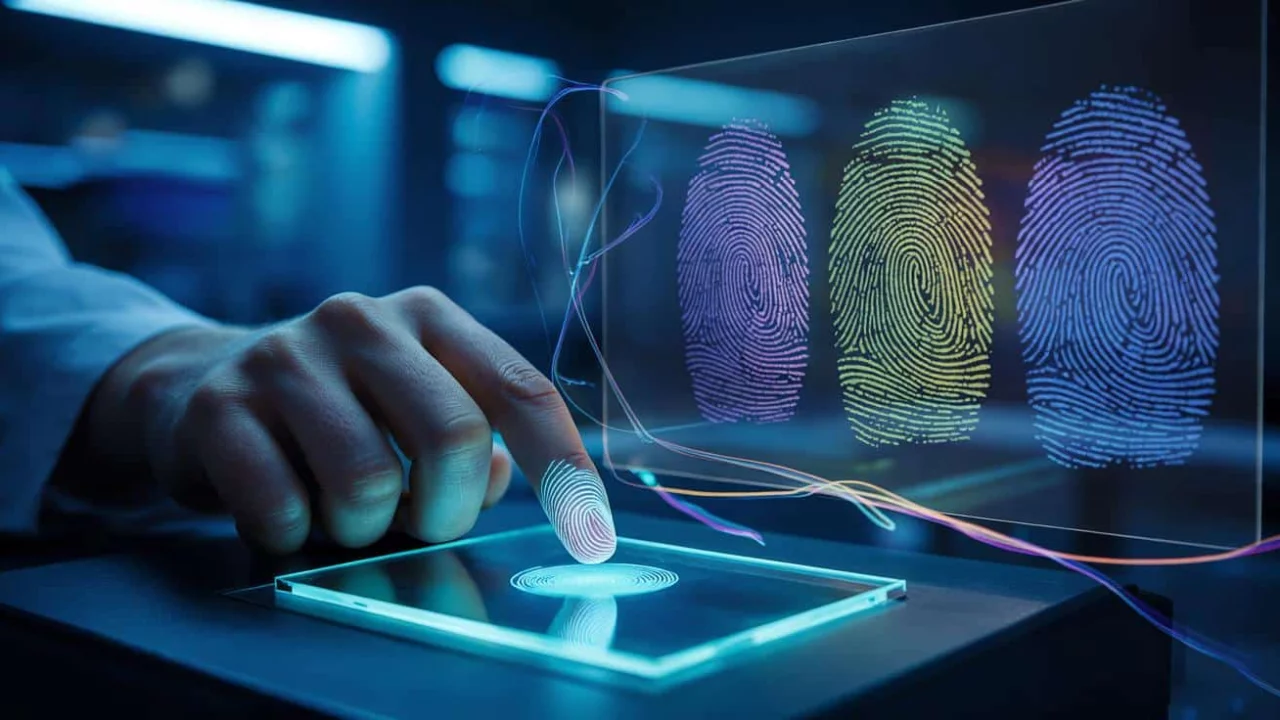
Detective Sarah Martinez stared at the fingerprint lifted from the apartment window, her coffee growing cold beside the case file. Twenty years on the force, and she’d seen this scenario countless times: a partial print that didn’t match anything in the database. The burglar had been careful, wearing gloves most of the time, but left behind just one smudged thumbprint on the glass. In the old days, this would be another dead end. But last week, her lab got access to new AI software that promised something she’d never seen before – the ability to connect fingerprints from different fingers of the same person.
What happened next would have seemed like science fiction just two years ago. The AI didn’t just analyze the thumbprint’s tiny details. It looked at the broader patterns, the flow of the ridges, the overall architecture of the print. Within minutes, it flagged a match to a different case from across town – not the same finger, but potentially the same person.
Sarah’s case represents a seismic shift happening in forensic laboratories worldwide, one that could fundamentally change how we solve crimes and think about fingerprint evidence.
How AI Is Rewriting The Fingerprint Rulebook
For over a century, fingerprint analysis has operated on a simple principle: each finger is unique, and fingers from the same person are essentially independent of each other. Forensic experts have trained their eyes to spot “minutiae” – those tiny points where ridges end, split, or form islands. These details have been considered completely random, even between fingers on the same hand.
But researchers from Columbia University and the University at Buffalo have shattered this assumption using artificial intelligence. Their AI system, trained on approximately 60,000 fingerprint images, discovered something human experts had missed for generations.
“We were honestly skeptical at first,” says Dr. Aniv Ray, one of the lead researchers. “The idea that you could link different fingers from the same person seemed to go against everything we knew about fingerprint science.”
Instead of focusing on those microscopic details that human examiners rely on, the AI stepped back to see the forest instead of the trees. It analyzed the overall flow and angle of ridge patterns, particularly around the center of each fingertip. What it found was remarkable: subtle structural themes that repeat across all ten fingers of the same individual.
Think of it like handwriting. While each word you write looks different, there’s an underlying style that connects them all. Similarly, each person appears to carry a faint but consistent “signature” across their fingerprints – invisible to human eyes but crystal clear to the algorithm.
The Numbers That Are Making Forensic Labs Take Notice
The research team’s findings include some eye-opening statistics that are forcing the forensic community to reconsider long-held beliefs about fingerprint evidence:
| Metric | Result | Significance |
|---|---|---|
| AI Confidence Level | 99.99% | Extremely high statistical certainty when flagging matches |
| Accuracy Rate | 77% | Correctly matched different fingers from same person |
| Training Data | 60,000 fingerprints | Massive dataset enabling pattern recognition |
| Human Baseline | Effectively 0% | Previous capability was considered impossible |
At first glance, 77% accuracy might not seem impressive in our world of “99.9% accurate” biometric systems. But here’s the crucial context: before this AI breakthrough, the ability to link different fingers from the same person was essentially zero.
“Going from impossible to working three out of four times isn’t just an improvement – it’s the creation of an entirely new forensic capability,” explains forensic scientist Dr. Jennifer Walsh, who wasn’t involved in the research but has been following its implications.
The AI’s approach reveals fascinating insights about fingerprint AI patterns that humans had never detected:
- Ridge flow angles show consistent mathematical relationships across fingers
- Central fingerprint regions contain more cross-finger similarities than peripheral areas
- The AI identifies patterns at scales both larger and smaller than traditional minutiae analysis
- These patterns remain detectable even in partial or degraded prints
What makes this discovery even more significant is how the AI learned these patterns. Unlike human experts who are trained to look for specific features, the machine developed its own methodology through deep learning, uncovering relationships that had been hiding in plain sight.
What This Means For Criminal Justice And Personal Security
The implications of this fingerprint AI patterns breakthrough extend far beyond academic curiosity. We’re looking at potential changes that could reshape criminal investigations, legal proceedings, and personal privacy in ways we’re only beginning to understand.
Consider how criminal investigations currently work. When investigators find a fingerprint at a crime scene, they search for an exact match in databases. If they find a print from someone’s right index finger on a weapon, but later discover a left thumb print at another scene, those cases remain separate unless connected by other evidence.
This new AI capability changes that equation entirely. Suddenly, investigators could potentially link crime scenes even when different fingers left the evidence behind.
“This could be the biggest change in fingerprint analysis since automated fingerprint identification systems were introduced in the 1990s,” notes crime lab director Mike Stevens. “We’re talking about solving cold cases that have been sitting in filing cabinets for years.”
But the technology raises equally important concerns about privacy and civil liberties:
- Expanded surveillance capabilities could track individuals across multiple crime scenes more easily
- False positives, even at low rates, could implicate innocent people
- Existing fingerprint databases might need complete reanalysis using AI systems
- Legal standards for fingerprint evidence may require fundamental revision
The security industry is also paying close attention. Current biometric systems typically require you to use the same finger consistently – your right thumb to unlock your phone, for instance. If AI can reliably link different fingers from the same person, security systems could become both more flexible and more secure.
However, this same capability could make it harder to maintain anonymity in our increasingly surveilled world. “If every fingerprint becomes potentially linkable to every other fingerprint from the same person, the privacy implications are staggering,” warns digital rights advocate Maria Rodriguez.
Legal experts are already debating how courts should handle this new evidence. The 77% accuracy rate, while groundbreaking, falls short of the near-certainty traditionally expected from fingerprint evidence. This could lead to complex legal battles about admissibility and weight of evidence.
Perhaps most intriguingly, this research suggests we might have been fundamentally wrong about fingerprint uniqueness. If AI can spot patterns linking our fingers, what other hidden connections might exist in biometric data we thought we understood?
The researchers are already working on improving their system’s accuracy and testing it on larger, more diverse datasets. Early results suggest the 77% figure might just be the beginning – newer versions of the AI are showing even better performance.
As this technology moves from research labs to real-world applications, we’re entering uncharted territory. The same tools that could help solve decades-old crimes might also create new challenges for privacy and civil liberties that our legal and social systems aren’t prepared to handle.
FAQs
How accurate is the new AI fingerprint technology?
The AI correctly matches fingerprints from different fingers of the same person about 77% of the time, with 99.99% confidence when it does make a match.
Can this technology identify people from partial fingerprints?
Yes, the AI analyzes overall ridge patterns rather than just specific minutiae, making it potentially effective even with partial or degraded prints.
Will this change how fingerprint evidence is used in court?
Likely yes, as the 77% accuracy rate raises new questions about evidence standards and could lead to legal challenges about admissibility.
Could this technology violate privacy rights?
Privacy advocates are concerned that linking different fingers from the same person could expand surveillance capabilities and make anonymous biometric data more identifiable.
How many fingerprints was the AI trained on?
The system learned from approximately 60,000 fingerprint images, allowing it to discover patterns invisible to human experts.
When will this technology be available to law enforcement?
The research is still in early stages, but forensic labs are already expressing interest in testing and implementing these AI systems.











Leave a Comment