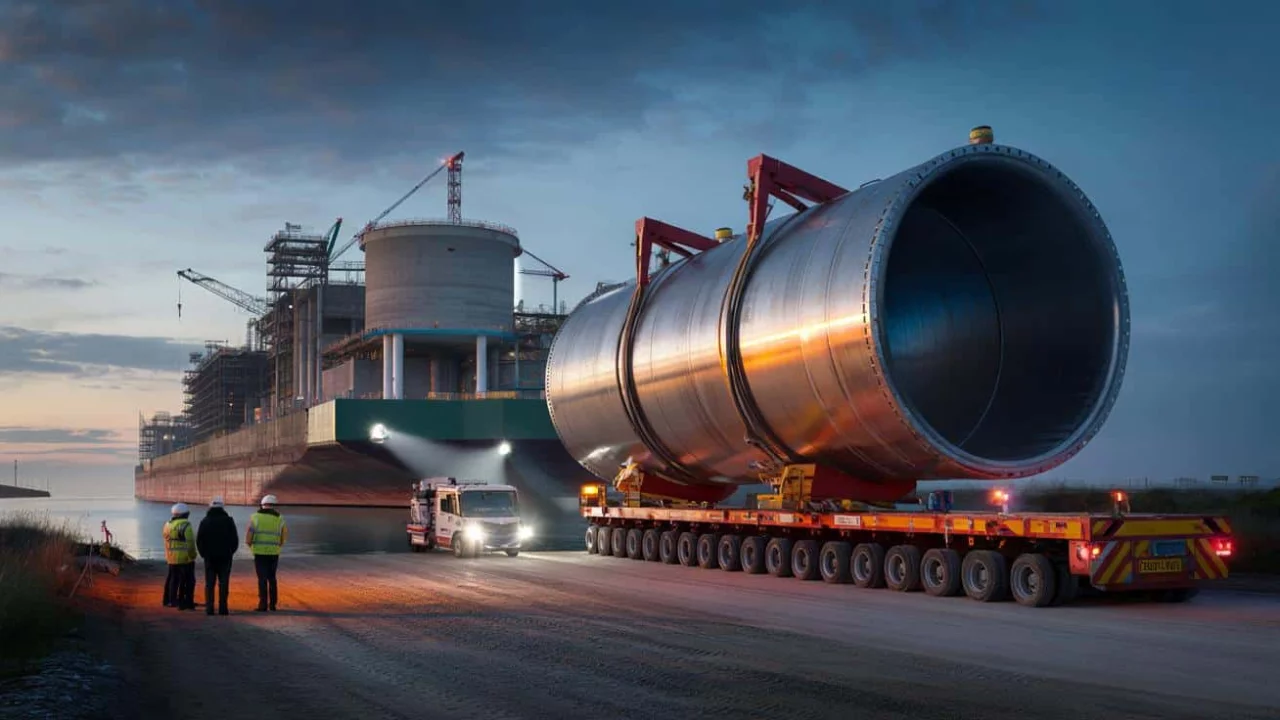
Picture this: you’re driving through quiet Somerset countryside when suddenly you encounter something that looks like a scene from a science fiction movie. A massive steel cylinder, longer than three buses parked end-to-end, creeps along narrow country roads at walking speed. Police cars flash their lights ahead and behind, while engineers in high-visibility jackets nervously monitor every inch of progress.
This wasn’t some movie set or elaborate stunt. This was the final moments of an extraordinary 1,000-kilometre journey that began in a French factory and ended at one of Britain’s most controversial construction sites. The cargo? A 500-tonne piece of steel that will literally power millions of homes for the next eight decades.
Welcome to the logistical nightmare and engineering marvel that is delivering the heart of Hinkley Point C nuclear power station.
The Beast That Crossed Europe
On January 12th, 2026, something remarkable happened at Hinkley Point C. After days of meticulous planning and nerve-wracking transport, the reactor pressure vessel for the plant’s second unit finally arrived at its destination. This isn’t just any piece of equipment – it’s the absolute core of what will become Britain’s most powerful nuclear reactor.
Built by French nuclear specialist Framatome at their Saint-Marcel facility, this steel giant weighs as much as a fully loaded Boeing 747 and stretches 13 metres in length. Think of it as the beating heart of a nuclear power station. Without it, nothing else matters.
“Once this vessel is installed, the entire reactor design locks around it,” explains nuclear engineer Sarah Mitchell. “There’s no second chance, no replacement option. This is genuinely a one-shot operation that determines whether Hinkley Point C succeeds or fails.”
Inside this massive steel cylinder, nuclear fuel assemblies will generate the heat that eventually lights up your home. Water under crushing pressure will circulate through it, carrying thermal energy to steam generators. Control rods will slide up and down, regulating the nuclear reaction with precision that would make a Swiss watchmaker jealous.
A Journey That Redefined “Careful Handling”
Moving a 500-tonne reactor vessel across international borders isn’t like shipping a refrigerator. Every single kilometre of the journey required months of planning, with transport engineers scrutinising bridges, roundabouts, and road surfaces like archaeologists examining ancient artifacts.
Here’s how this epic delivery unfolded:
| Journey Stage | Transport Mode | Key Details |
|---|---|---|
| Saint-Marcel to Channel | Specialist road transporter | Multiple days crossing France |
| Channel crossing | Cargo ship | Weather-dependent timing |
| Avonmouth to Combwich | River barge | Via River Parrett |
| Final delivery | Road convoy | 6.4 km in 6 hours |
The final road leg tells the whole story. Just 6.4 kilometres took six hours to complete. That’s slower than most people walk to their local shop. Why? Because one wrong calculation, one miscalculated turning radius, one underestimated bridge clearance, and the entire Hinkley Point C project could face catastrophic delays.
“We reinforced road surfaces, widened corners, and even removed street furniture,” says transport logistics coordinator Mark Thompson. “Every single obstacle was identified and solved months before the vessel left France. There was simply no room for improvisation.”
- Total journey distance: Over 1,000 kilometres
- Maximum road speed: Walking pace
- Pre-journey planning: 18 months
- Transport modes used: Road, sea, river, road again
- Police escort vehicles: 12 throughout UK portion
- Weather windows monitored: 72 hours ahead
Why This Single Component Changes Everything
You might wonder why one piece of steel matters so much. The answer lies in what nuclear engineers call “defence in depth” – the reactor pressure vessel isn’t just a container, it’s the primary safety barrier protecting everyone within hundreds of kilometres.
This steel shell must withstand conditions that would destroy almost anything else humans have ever built. Internal pressures exceed 100 times normal atmospheric pressure. Temperatures soar close to 320°C. Neutron radiation bombards the metal continuously for more than 80 years. Yet it must never crack, never leak, never fail.
“The pressure vessel is designed for the reactor’s entire operational lifetime,” explains nuclear safety specialist Dr. James Crawford. “Once it’s welded into the reactor building, any attempt to replace it would mean shutting down the entire unit permanently.”
For Hinkley Point C, this delivery represents a crucial milestone. The project has faced years of delays, cost overruns, and political controversy. But with both reactor pressure vessels now on site, construction can advance toward the finish line.
British households are watching closely. When complete, Hinkley Point C will generate enough electricity to power 6 million homes for 60 years. That’s roughly 7% of Britain’s total electricity needs, supplied by clean nuclear energy that produces no carbon emissions during operation.
“This isn’t just about building a power station,” notes energy policy analyst Rebecca Foster. “It’s about Britain’s entire energy independence strategy. Every component that arrives brings us closer to reliable, carbon-free electricity that doesn’t depend on weather conditions or international gas prices.”
The economic impact extends far beyond electricity generation. Hinkley Point C supports thousands of construction jobs today and will employ hundreds of permanent workers for decades. Local communities around Somerset are already seeing increased business, improved infrastructure, and economic opportunities that will last well beyond the construction phase.
For the engineers who watched that massive steel cylinder crawl through Somerset lanes, the successful delivery marks more than logistics triumph. It represents Britain taking a giant step toward energy security, climate goals, and technological independence that will benefit generations to come.
FAQs
How much does the Hinkley Point C reactor pressure vessel weigh?
The vessel weighs approximately 500 tonnes, roughly equivalent to a fully loaded Boeing 747 aircraft.
How long did the entire journey take from France to Somerset?
The complete journey took several days, with the final 6.4-kilometre road section alone requiring six hours to complete at walking speed.
Why was the transport so slow and careful?
The vessel is irreplaceable and worth millions. Any damage during transport could delay the entire Hinkley Point C project by months or years.
How long will this reactor vessel operate?
The vessel is designed to operate safely for more than 80 years, powering millions of homes throughout its operational lifetime.
What happens if the reactor pressure vessel fails?
The vessel is built to never fail, but if it did, the entire reactor unit would need permanent shutdown since replacement is impossible once installed.
When will Hinkley Point C start generating electricity?
With both reactor vessels now delivered, the plant is expected to begin commercial operation in the late 2020s, pending completion of remaining construction work.











Leave a Comment