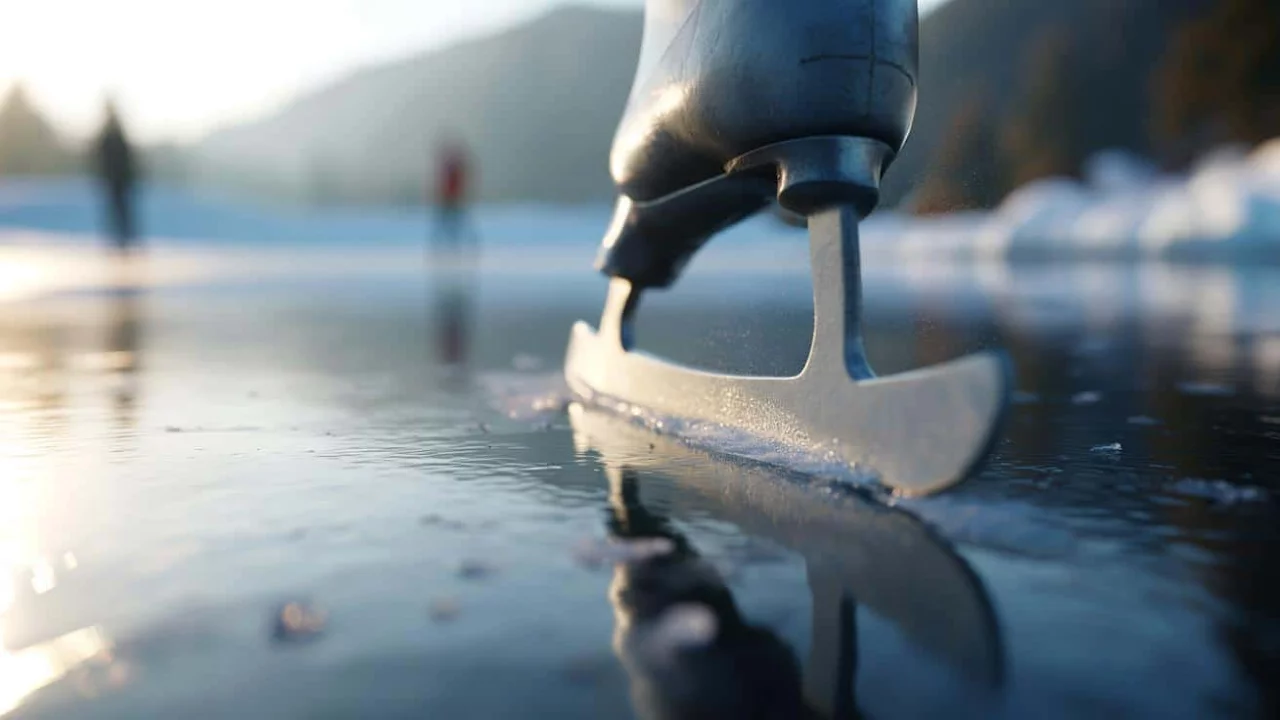
Last winter, I watched my four-year-old nephew take his first tentative steps onto our frozen backyard pond. One moment he was standing confidently in his tiny snow boots, the next he was flat on his back, legs flailing like an overturned turtle. Through his tears and my laughter, he asked the question that has puzzled humans for generations: “Why is ice so slippery, Uncle Jake?”
I gave him the same answer most of us learned in school – something about pressure melting the ice and creating a thin layer of water. It sounded scientific enough to satisfy a preschooler, but deep down, I realized I didn’t really understand it myself.
Turns out, neither did science. Until now.
The Century-Old Mystery Finally Gets Solved
For more than 100 years, physics textbooks have been telling us the same comfortable story about why ice is slippery. The explanation seemed logical: when you step, skate, or drive on ice, the pressure from your weight melts the top layer, creating a microscopic film of water that acts like nature’s own lubricant.
But here’s the thing – that explanation has some serious holes. Ice skaters glide effortlessly across rinks at -20°C, where there shouldn’t be nearly enough pressure to melt anything. Cars still skid on roads when it’s brutally cold outside. Even penguins can slide on their bellies across Antarctic ice that’s colder than your home freezer could ever dream of being.
“The traditional pressure-melting theory just doesn’t add up when you look at real-world conditions,” explains Dr. Sarah Chen, a materials physicist at MIT who wasn’t involved in the recent study. “We needed to dig deeper to understand what’s really happening at the molecular level.”
That’s exactly what a team led by physicist Martin Müser at Saarland University decided to do. Instead of conducting messy experiments on scratched-up ice rinks, they turned to something much more powerful: massive computer simulations that could peek into the molecular world of ice crystals.
What Makes Ice Slippery: The Real Science Behind the Slip
The breakthrough came when researchers used advanced computer models to simulate two perfectly flat ice crystals sliding against each other at temperatures just 10 degrees above absolute zero. We’re talking about -263°C here – so cold that there’s virtually no thermal energy for traditional melting.
Yet even at these mind-numbing temperatures, the simulated ice remained surprisingly slippery. The secret wasn’t liquid water at all.
Here’s what actually happens when ice becomes slippery:
- Surface molecules behave differently: The top layer of ice crystals isn’t as rigid as the interior structure
- Semi-liquid state: Surface molecules exist in a weird in-between state – not quite liquid, not quite solid
- Molecular flexibility: These surface molecules can wiggle, rearrange, and flow under pressure
- Natural lubrication: This “soft skin” absorbs friction instead of creating resistance
- No melting required: The slipperiness works even without any water formation
“Think of it like having a carpet on top of a concrete floor,” says Dr. Michael Rodriguez, a surface chemistry expert at Stanford. “The carpet can shift and move even when the concrete underneath stays perfectly rigid.”
| Temperature Range | Primary Slipping Mechanism | Real-World Example |
|---|---|---|
| Near 0°C | Soft surface + pressure melting | Ice skating rinks |
| -10°C to -20°C | Mainly soft surface layer | Outdoor winter sports |
| Below -30°C | Pure surface molecular mobility | Antarctic ice sheets |
The research team used a sophisticated ice model called TIP4P/Ice, which accurately reproduces how real ice behaves in terms of density, melting point, and crystal structure. When they ran their simulations, they discovered that molecules at the ice surface have fewer neighbors than those buried deep inside the crystal. This makes them less tightly bound and more free to move around.
Why This Discovery Changes Everything We Know
This isn’t just academic curiosity – understanding why ice is slippery has real consequences for millions of people every day. From designing better winter tires to improving ice rink maintenance, this knowledge could save lives and money.
Consider the practical implications. Every winter, icy roads cause thousands of accidents and cost billions in damages. Traditional approaches to ice safety have focused on melting or providing mechanical grip. But if ice slipperiness comes from molecular-level surface properties, we might need completely different solutions.
“Now that we understand the real mechanism, we can start thinking about surface treatments that might disrupt this molecular mobility,” notes Dr. Chen. “Maybe we don’t need to melt ice or cover it with sand – maybe we can change how those surface molecules behave.”
The discovery also explains some puzzling observations that never quite fit the old pressure-melting theory:
- Why ice remains slippery even at extremely low temperatures
- How lightweight objects can still slide easily on ice
- Why some types of ice seem more slippery than others
- How animals like penguins can slide so efficiently
For athletes and sports equipment manufacturers, this research opens up new possibilities. Ice skate designs, curling stone surfaces, and even ski wax formulations might all benefit from understanding the true nature of ice slipperiness.
“We’re looking at potentially revolutionary changes in winter sports equipment,” explains former Olympic speed skater turned sports scientist Dr. Lisa Park. “If we can engineer surfaces that interact more effectively with ice’s soft molecular layer, we could see performance improvements across multiple sports.”
The research also has implications for climate science. Understanding ice behavior at the molecular level could help scientists better model how glaciers move, how ice sheets respond to temperature changes, and even how ice crystals form in clouds.
Perhaps most importantly, this discovery reminds us that science is far from finished. Even something as simple as slipping on ice – an experience shared by nearly every human who lives in a cold climate – still held secrets waiting to be unlocked by modern technology and clever thinking.
So the next time you watch someone gracefully glide across an ice rink or carefully navigate an icy sidewalk, you’ll know the real story. It’s not just melted water making things slippery – it’s the ice itself, with its weird, wonderful surface molecules dancing in their semi-liquid state, ready to let anything slide right over them.
My nephew might be too young to understand molecular mobility and surface crystalline structure, but at least now I can give him a better answer than “pressure melting.” Sometimes the most familiar things in our world are the most mysterious – until science finally catches up.
FAQs
Does ice only get slippery when it melts?
No, recent research shows ice can be slippery even at extremely cold temperatures where no melting occurs. The slipperiness comes from molecules at the ice surface behaving in a semi-liquid state.
Why can penguins slide on ice that’s way below freezing?
Penguins can slide because ice has a naturally “soft” molecular surface layer that acts like a lubricant, regardless of temperature. No pressure melting is required.
Is all ice equally slippery?
Not necessarily. The type of ice crystal, surface texture, and temperature all affect slipperiness. Perfectly smooth ice with an active molecular surface layer will be most slippery.
Will this discovery help make roads safer in winter?
Potentially yes. Understanding the real mechanism behind ice slipperiness could lead to new surface treatments or tire designs that better interact with ice’s molecular properties.
How did scientists figure this out after so many years?
Advanced computer simulations allowed researchers to study ice behavior at the molecular level under perfect conditions, something impossible with traditional experiments.
Does this mean the pressure-melting theory was completely wrong?
Not entirely. Pressure melting can still contribute to slipperiness near 0°C, but it’s not the main or only mechanism. The molecular surface layer is the primary cause of ice being slippery.











Leave a Comment