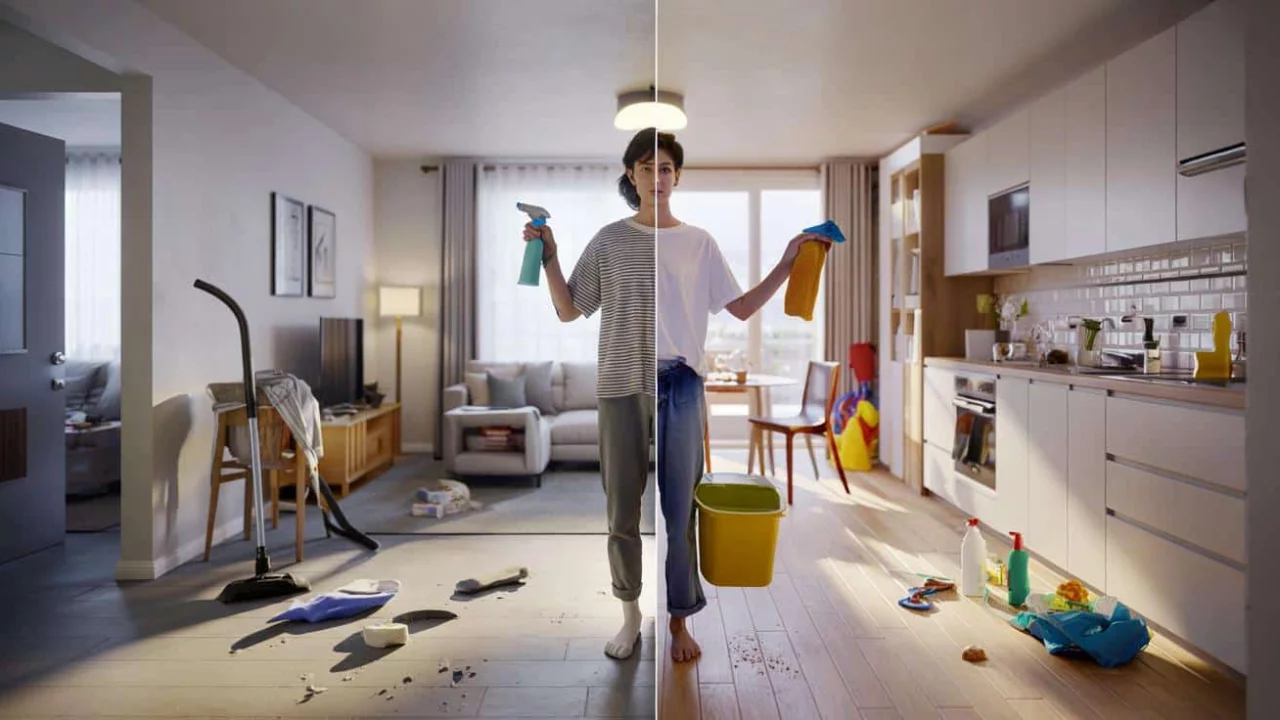
Sunday afternoon. The vacuum is out again, the laundry basket is overflowing, and you’re halfway through wiping the kitchen counter when your phone lights up with a message: “Coming for coffee?” You glance at the crumbs under the table, the bathroom you “kind of” cleaned yesterday, and you already know the answer. You’re not going anywhere.
You’ve spent the whole weekend “tidying” and yet the apartment looks strangely unchanged. The sponge drama repeats every week, the same gestures, the same half-finished jobs, pockets of mess that come back faster than you can chase them.
The strange thing is, you’re not lazy. You’re just stuck in a cycle of inefficient cleaning that quietly steals hours from your life.
Where your cleaning time really disappears
Watch yourself during your next “big clean”. There’s a good chance you’re doing the housework equivalent of mindless scrolling: a bit here, a bit there, lots of movement, not much progress. You wipe a shelf, remember the laundry, open the machine, start a cycle, then notice the bathroom mirror. Two minutes later, you’re hunting for the glass spray you left in the living room.
This constant zigzagging feels busy and even satisfying at times. Your brain likes the feeling of “doing something”. But at the end of two hours, the place doesn’t look two hours cleaner. It just looks slightly less chaotic.
“Most people clean the same way they grocery shop without a list,” explains professional organizer Sarah Chen, who has helped over 800 households streamline their routines. “They wander around hoping to remember what needs doing, then wonder why it takes forever.”
Take Emma, 34, who swore she cleaned “all the time” yet always felt behind. One Saturday she timed herself. Seventeen minutes walking from room to room carrying single items. Thirteen minutes searching for cleaning products and cloths she’d left “somewhere over there”. Twenty-one minutes redoing tasks she’d half-finished when her coffee got cold.
That’s fifty-one minutes of a two-hour cleaning session spent on pure inefficiency. No wonder Sunday felt wasted.
The hidden time drains in your cleaning routine
Inefficient cleaning isn’t just about moving slowly. It’s about the small decisions and habits that compound into massive time sinks. Here are the biggest culprits robbing your weekends:
- The ping-pong effect: Jumping between rooms and tasks without finishing anything
- Supply hunting: Constantly searching for tools, products, and cleaning cloths
- The “good enough” trap: Half-cleaning surfaces that need redoing within days
- Wrong-tool syndrome: Using whatever’s handy instead of the right equipment
- Clutter shuffling: Moving mess around instead of dealing with it
- Surface-only cleaning: Ignoring the root causes that create quick re-mess
The numbers tell the story. Research from the American Time Use Survey shows the average person spends 1.8 hours daily on household activities, but homes with inefficient cleaning systems report feeling “never clean” despite the time investment.
| Inefficient Habit | Time Lost Per Session | Weekly Impact |
|---|---|---|
| Walking between rooms with single items | 15-20 minutes | 1+ hour |
| Searching for supplies | 10-15 minutes | 45 minutes |
| Redoing half-finished tasks | 20-30 minutes | 1.5 hours |
| Clutter shuffling without organizing | 25-35 minutes | 2 hours |
“The biggest shift happens when people realize cleaning isn’t about working harder, it’s about working in the right order,” says home efficiency expert Marcus Rodriguez. “Most people are essentially doing the same job three times over.”
Why inefficient cleaning becomes a weekly prison
The cruel irony of poor cleaning habits is how they multiply. When you don’t finish a task properly, it creates more work next time. That bathroom mirror you quickly wiped? The streaks mean you’ll notice it needs cleaning again tomorrow. The kitchen counter you cleared but didn’t actually clean? Crumbs stick faster to the leftover grime.
This creates what cleaning professionals call the “hamster wheel effect”. You’re always cleaning, always busy, but never actually ahead. The mess regenerates faster than your inefficient system can handle it.
Families with children feel this most acutely. Parent surveys show that 73% spend more than 10 hours weekly on cleaning-related activities, yet only 31% describe their homes as “clean most of the time”. The gap isn’t effort – it’s method.
“I used to clean the playroom every single day,” shares Jennifer, mother of three. “Twenty minutes of picking up toys, wiping surfaces, straightening books. Then I learned about zone cleaning and batch processing. Now I spend forty minutes every three days and the room actually stays clean.”
The ripple effects extend beyond housework. Inefficient cleaning steals time from relationships, hobbies, rest, and spontaneous plans. That coffee invitation you declined? It happens more often than you realize. The book gathering dust, the hobby supplies in boxes, the friends you keep meaning to call – inefficient cleaning doesn’t just waste time, it quietly shrinks your life.
Professional cleaner Tom Williams, who has optimized systems for over 2,000 homes, puts it simply: “When people call me, they’re not usually struggling with dirt. They’re struggling with time. The dirt is just what they can see.”
The solution isn’t cleaning more or buying fancier products. It’s cleaning smarter. Simple changes to your approach – cleaning top to bottom, gathering all supplies first, focusing on one room completely before moving to the next – can cut your cleaning time in half while achieving better results.
Most people who make these adjustments report getting back 3-5 hours per week. That’s not just time for coffee dates. That’s time for the life you’re actually trying to create between all the cleaning.
FAQs
How much time does inefficient cleaning really waste?
Studies show inefficient cleaning habits can waste 2-4 hours per week through task-switching, supply hunting, and redoing incomplete work.
What’s the biggest mistake people make when cleaning?
Jumping between rooms and tasks without finishing anything completely, which creates more work and wastes time walking around with single items.
How can I tell if my cleaning routine is inefficient?
If you feel like you’re always cleaning but your home never stays clean, or if cleaning takes up most of your weekend, your system likely needs improvement.
Should I clean one room at a time or the whole house at once?
Focus on completing one room entirely before moving to the next. This prevents the time waste of walking between rooms and ensures each space gets properly finished.
What supplies should I gather before starting to clean?
Bring all cleaning products, cloths, trash bags, and tools to each room in a caddy or basket to avoid constant trips back and forth.
How often should I deep clean versus quick tidy?
Quick daily maintenance (5-10 minutes per room) prevents the need for exhausting weekend deep cleans that steal your free time.











Leave a Comment