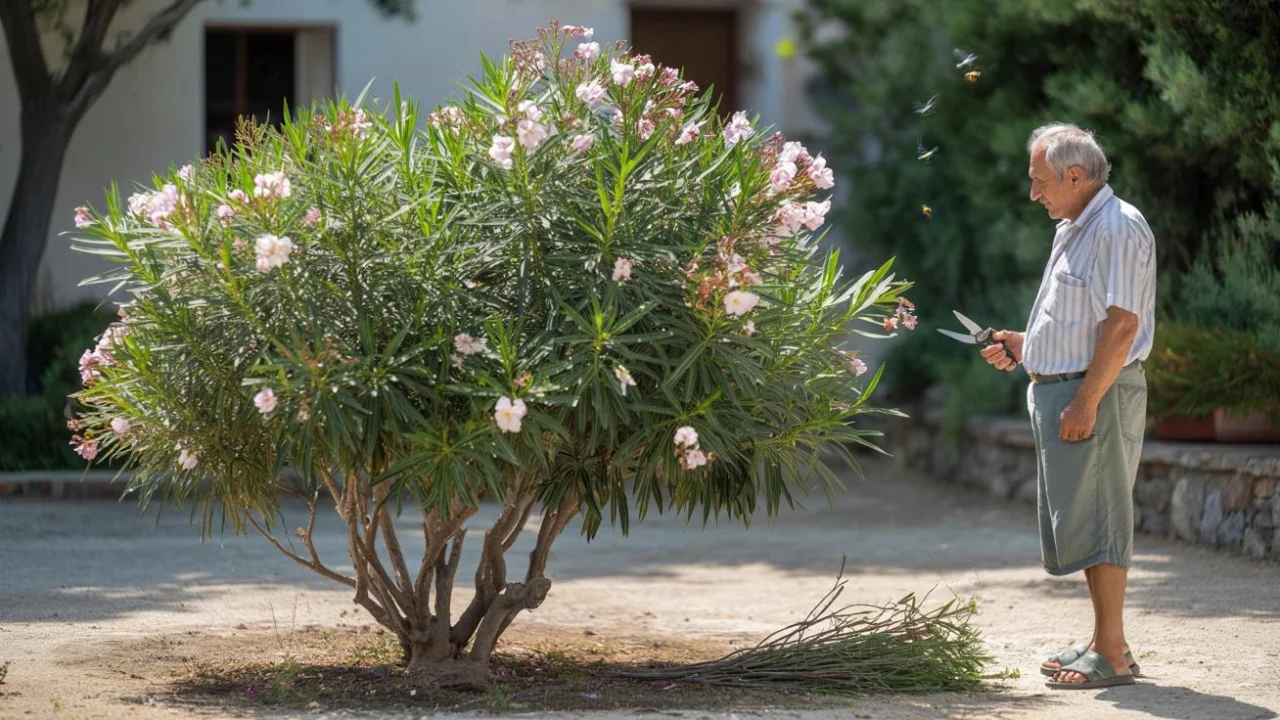
Last summer in Crete, I watched my neighbor Maria step into her garden at dawn, coffee still steaming in one hand, pruning shears loose in the other. Her enormous white oleander had grown wild over the winter—branches reaching in every direction, some nearly touching the ground.
I expected her to start hacking away like I’d seen gardeners do back home. Instead, she made three gentle cuts, removing only dead flower heads and one crossing branch. Then she stepped back, sipped her coffee, and nodded approvingly.
“My grandmother always said oleanders know their own shape,” she told me later. “We just help them remember it.”
The gentle art of Mediterranean oleander pruning
Across the Mediterranean, from the Greek islands to the Spanish coast, gardeners have perfected a pruning approach that seems almost lazy compared to our northern methods. They barely touch their oleanders, yet these shrubs bloom more abundantly and live longer than heavily pruned ones.
The secret lies in understanding oleander biology. These plants evolved in hot, dry climates where harsh cutting would expose them to disease and stress. Mediterranean gardeners work with this natural tendency rather than against it.
“In Cyprus, we say oleanders are like stubborn children,” explains Dimitri Kostas, a third-generation landscaper from Limassol. “Push them too hard and they’ll refuse to cooperate.”
This gentle approach produces results that speak for themselves. Mediterranean oleanders often bloom from spring through fall, their natural fountain shape creating stunning displays that require minimal maintenance.
What Mediterranean pruning actually looks like
Traditional Mediterranean oleander pruning follows specific principles that maximize flowering while maintaining plant health. Here’s how experienced Mediterranean gardeners approach their oleanders:
- Timing matters: Light pruning right after flowering ends, never during active growth
- Minimal cuts: Remove only 10-15% of branches per year
- Focus on health: Dead, diseased, or crossing branches get priority
- Preserve the crown: Never cut main stems below knee height
- Hand-picking: Many gardeners simply pinch spent flowers instead of cutting
The tools are equally minimal. Most Mediterranean gardeners use small hand pruners and occasionally a long-handled lopper for high branches. Power tools rarely make an appearance.
| Mediterranean Method | Northern Method | Results |
|---|---|---|
| Light trimming 1-2 times yearly | Heavy pruning annually | Mediterranean plants bloom 3x longer |
| Remove 10-15% of growth | Remove 30-50% of growth | Less stress, faster recovery |
| Preserve natural shape | Create formal shapes | Better wind resistance |
| Focus on health over appearance | Prioritize neat appearance | Fewer disease problems |
“We learned from watching wild oleanders in the hills,” says Antonio Reyes, who tends oleanders in public parks across Valencia. “They grow beautifully without any human interference at all.”
Why this approach transforms your garden
The benefits of Mediterranean oleander pruning extend far beyond just plant health. Gardeners who adopt this gentler approach often find their entire relationship with their landscape changes.
First, there’s the practical advantage. Less intensive pruning means less work, fewer tools, and lower maintenance costs. Many Mediterranean gardeners spend under an hour per year maintaining even large oleander hedges.
The ecological benefits are equally impressive. Loosely pruned oleanders provide better habitat for beneficial insects, birds, and small wildlife. Their natural shape offers varying levels of cover and nesting sites that formal pruning destroys.
“My oleanders became bird apartments when I stopped cutting them so hard,” reports Sarah Chen, an expat gardener in Portugal who switched to Mediterranean methods three years ago. “Now I have finches nesting there every spring.”
Perhaps most importantly, this approach creates more resilient plants. Oleanders pruned the Mediterranean way develop stronger root systems, better drought tolerance, and improved resistance to wind damage.
The visual impact often surprises newcomers to this method. Instead of the rigid, formal appearance of heavily pruned oleanders, Mediterranean-style plants develop graceful, flowing shapes that complement rather than dominate their surroundings.
Many gardeners find this creates a more relaxed, natural atmosphere in their outdoor spaces. The plants look like they belong in the landscape rather than imposed upon it.
Climate change makes this approach even more relevant. As summers become hotter and drier in many regions, the stress-reducing benefits of gentle pruning become crucial for plant survival.
“Plants that aren’t stressed by heavy cutting handle heat waves much better,” explains Dr. Elena Rodriguez, a horticulturist studying Mediterranean gardening techniques in southern Spain. “We’re seeing this pattern across many drought-tolerant species.”
The timing of Mediterranean pruning also aligns better with oleander biology. Rather than forcing plants to redirect energy into new growth during stressful summer months, gentle post-flowering trimming allows natural recovery cycles.
This seasonal alignment reduces water needs, minimizes fertilizer requirements, and often eliminates the need for supplemental plant care that heavily pruned oleanders typically require.
FAQs
When should I prune oleanders the Mediterranean way?
Right after flowering ends, typically late summer or early fall. Avoid pruning during active spring growth.
How much should I cut off my oleanders each year?
No more than 10-15% of the plant’s total growth. Focus on dead or crossing branches rather than overall size reduction.
Will my oleanders look messy with minimal pruning?
They’ll look more natural and flowing rather than formal. Most people find this more attractive once they adjust to the style.
Can this method work in cooler climates?
Yes, the reduced stress from gentle pruning actually helps oleanders survive colder winters better.
What if my oleanders are already heavily pruned?
Gradually transition by reducing pruning intensity over 2-3 years. The plants will slowly return to their natural form.
Do Mediterranean-pruned oleanders need more water?
Actually less. The reduced stress and stronger root systems improve drought tolerance significantly.










Leave a Comment