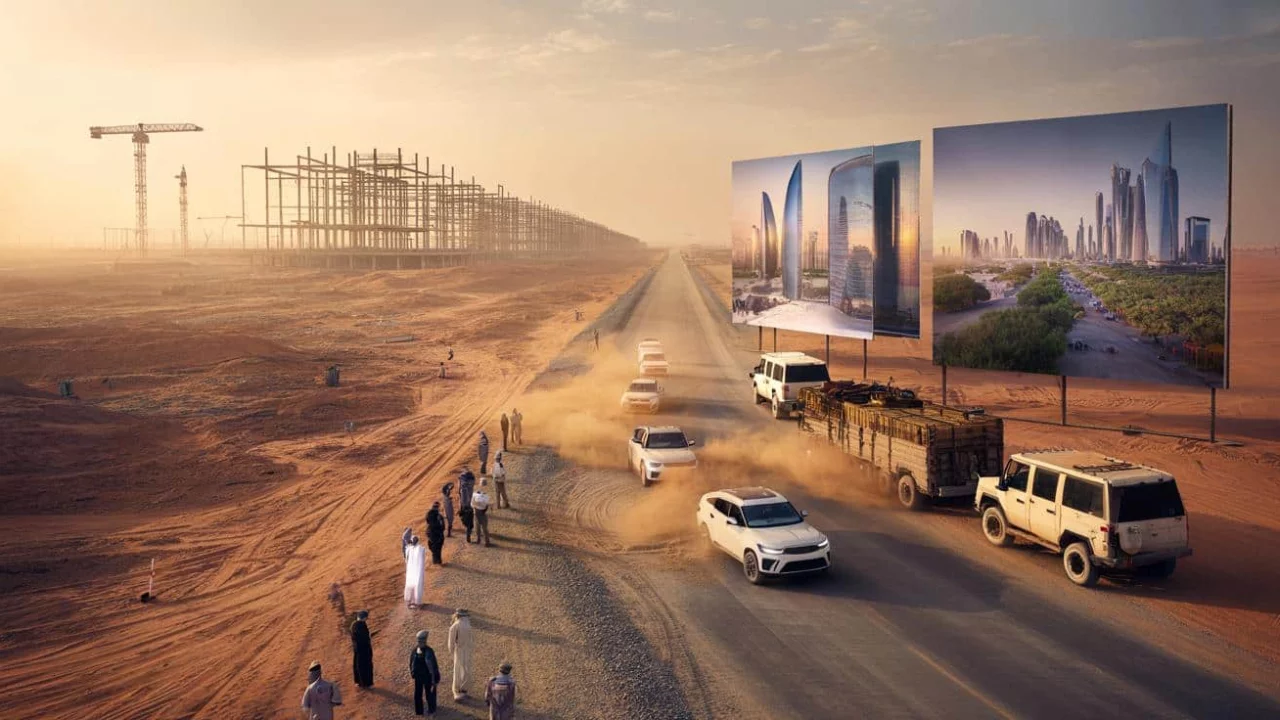
Ahmed pulls his pickup truck to the side of the desert highway and stares at what used to be his family’s grazing land. Where his goats once wandered, massive earth movers now crawl like metal beetles, carving straight lines through ancestral territory. The government compensation barely covered a year’s rent in Tabuk city, and now his teenage son asks every morning if they’ll ever go home.
“They promised us jobs in the new city,” Ahmed says, lighting another cigarette. “But first we had to leave so they could build paradise.”
This is the human cost of Saudi Arabia’s most ambitious gamble—the Neom desert megacity that was supposed to redefine civilization itself. Three years and over $100 billion later, the dream of a 100-mile linear city stretching across the northwestern desert has become a cautionary tale about unchecked ambition, displaced communities, and the growing silence around a project that once dominated headlines worldwide.
The mirage that swallowed billions
The Neom desert megacity began as Crown Prince Mohammed bin Salman’s signature vision for Saudi Arabia’s future. Announced in 2017 with Hollywood-style fanfare, “The Line” promised to house nine million residents in a linear city stretching from the mountains to the Red Sea, enclosed between two parallel mirrored walls 500 meters high.
Flying cars would zip between levels. Artificial intelligence would manage everything from traffic to trash. No pollution, no crime, no compromises with the messy realities of traditional urban planning.
“The original vision was breathtaking, but it ignored basic physics, economics, and human nature,” says Dr. Maria Santos, an urban planning expert who worked on early feasibility studies. “You can’t just decide that a city should be a straight line and expect nine million people to live there happily.”
The numbers tell the story of a project spinning out of control:
| Promised | Reality |
|---|---|
| Nine million residents by 2030 | Empty construction camps |
| 100-mile linear city | Less than 2 miles under construction |
| $500 billion total investment | Over $100 billion spent, minimal progress |
| World’s first cognitive city | Basic infrastructure still incomplete |
| Zero carbon emissions | Massive diesel generators powering construction |
Workers at the site describe a project in constant flux. Design changes arrive weekly. Entire sections get demolished and rebuilt. International contractors pack up and leave after payment disputes stretch for months.
The key problems that money can’t solve
Behind the glossy promotional videos, the Neom desert megacity faces fundamental challenges that no amount of Saudi oil wealth seems capable of resolving:
- Engineering impossibilities – Building a 500-meter-high mirrored wall across 100 miles of desert presents structural challenges that current technology cannot solve at scale
- Climate extremes – Summer temperatures exceed 50°C (122°F), making outdoor life nearly impossible for much of the year
- Water scarcity – The region lacks natural freshwater sources for a population of nine million
- Economic viability – No clear plan for how residents would earn a living in a desert linear city
- Cultural displacement – Local Huwaitat tribes forced from ancestral lands with inadequate compensation
“The physics just don’t work,” explains Dr. James Mitchell, who consults on large-scale construction projects. “You can’t build a 500-meter wall that long without it collapsing under its own weight, especially in seismic zones.”
Environmental concerns compound the technical problems. The mirrored walls would create massive heat reflection, potentially altering local weather patterns and making life unbearable for surrounding communities. Wildlife migration routes would be severed permanently.
Who pays when utopian dreams crumble?
The retreat from the original Neom vision has been gradual but unmistakable. Official announcements now focus on “phases” and “initial sections” rather than the full 100-mile line. International media coverage has shifted from breathless promotion to skeptical analysis.
But the human cost continues mounting. Thousands of workers remain stranded at half-completed construction sites with uncertain pay. Local communities displaced for the project live in cramped urban apartments, watching their traditional lifestyle disappear on satellite images.
“My grandfather’s graves are somewhere under those excavations,” says Salma al-Huwaiti, whose family was relocated from the Neom area. “They promised to preserve our heritage, but they couldn’t even preserve our cemetery.”
International investors increasingly view Neom as a cautionary tale about due diligence in mega-projects. Several major contractors have quietly withdrawn from the project, citing concerns about realistic timelines and payment schedules.
“The question isn’t whether Neom will succeed—it’s who will be held accountable for the billions already spent with so little to show,” notes economist Dr. Helen Crawford, who tracks Middle Eastern development projects.
The Saudi government continues to promote smaller, more achievable components of Neom, including a ski resort and luxury beach developments. But these scaled-back plans bear little resemblance to the revolutionary urban experiment that captured global imagination.
For Ahmed and thousands like him, the promises of compensation and new opportunities ring increasingly hollow. His son has stopped asking about going home. There’s nothing left to go home to except construction zones and security fences.
The desert keeps its secrets, but the cranes and bulldozers can’t hide forever behind walls of public relations. Someone, eventually, must answer for this.
FAQs
What is the Neom desert megacity?
Neom is Saudi Arabia’s planned $500 billion linear city project, designed to stretch 100 miles through the northwestern desert and house nine million people between mirrored walls.
How much money has Saudi Arabia spent on Neom?
Over $100 billion has been spent so far, with minimal visible progress on the main linear city concept.
Why is the Neom project facing problems?
The project faces engineering impossibilities, extreme climate challenges, water scarcity, and lacks economic viability for attracting nine million residents to a desert location.
What happened to local communities displaced by Neom?
Local Huwaitat tribes were forced from ancestral lands with inadequate compensation, losing traditional grazing grounds and cultural sites including burial grounds.
Is the Neom project completely abandoned?
No, but the scope has been dramatically scaled back to focus on smaller developments like resorts rather than the original 100-mile linear city.
Will Neom ever be completed as originally planned?
Experts consider the original vision technically impossible and economically unfeasible, making completion highly unlikely.











Leave a Comment