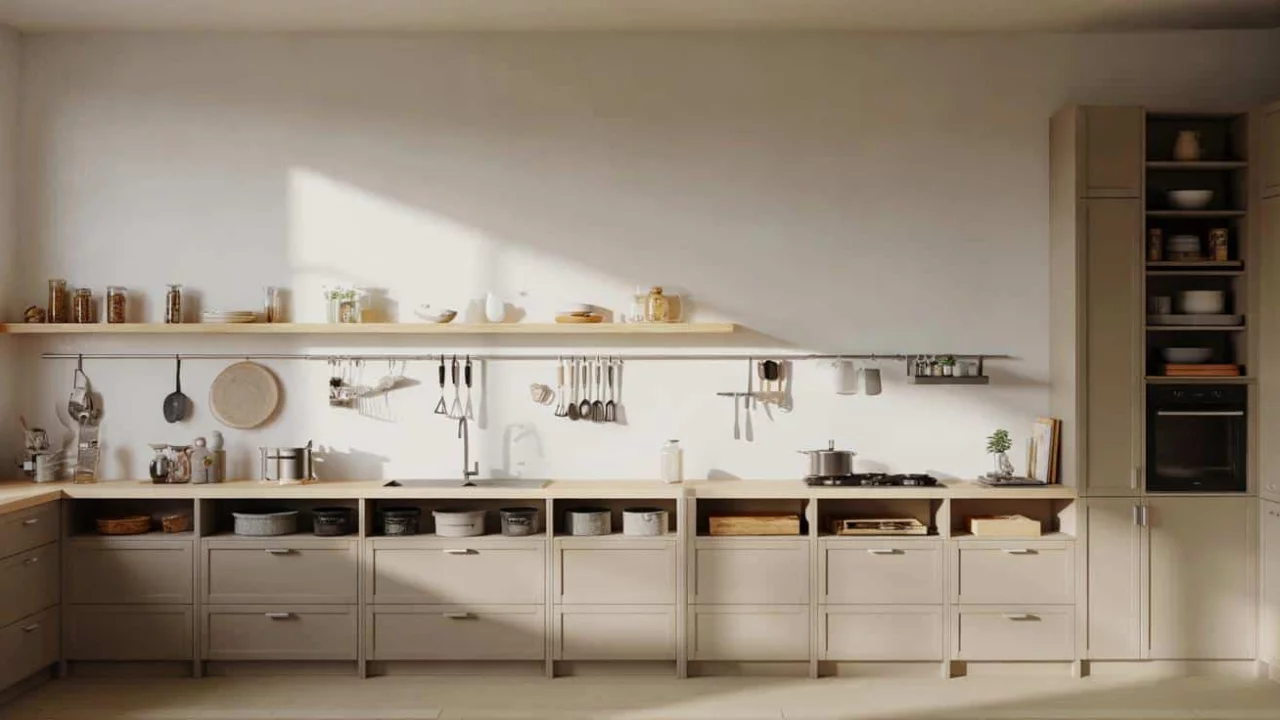
Last month, my friend Sarah invited me over to see her “new” kitchen. I walked in expecting granite countertops and glossy cabinet doors, but instead found myself staring at bare walls. No upper cabinets at all. Just floating shelves displaying colorful bowls, a sleek rail holding copper pots, and drawers that glided open with the softest touch.
“Where’s the rest of it?” I asked, genuinely confused. Sarah laughed and handed me a coffee cup from one of those open shelves. “This is it,” she said. “And it cost me half what my neighbor spent on her traditional kitchen.”
That was my introduction to the open shelving kitchen revolution quietly transforming homes across the country.
The great cabinet exodus is happening right now
Walk into any traditional kitchen and look up. You’ll see rows of closed boxes, often slightly warped at the corners where years of steam have worked their slow magic. Those upper cabinets that cost thousands? They’re usually the first casualties of real kitchen life.
The open shelving kitchen trend throws that whole system out the window. Instead of wall-mounted cabinets, homeowners are choosing floating shelves, industrial rails, and maximizing lower storage with deep drawers that actually work.
“I’ve been installing kitchens for fifteen years, and I’d say 40% of my callback visits are for upper cabinet problems,” explains Mike Peterson, a kitchen installer from Portland. “Doors that won’t close properly, shelves sagging under weight, that yellowing you get around the hinges from steam.”
The open shelving approach sidesteps these issues entirely. No doors means no warping. No enclosed spaces means no mold buildup. No complex hinge systems means nothing to break.
Breaking down the real costs and benefits
Here’s where things get interesting from a budget perspective. Traditional upper cabinets can easily run $200-400 per linear foot once you factor in materials, hardware, and installation. An open shelving kitchen slashes those costs dramatically.
| Component | Traditional Cabinets | Open Shelving |
|---|---|---|
| Upper storage (10 ft) | $2,000-4,000 | $300-800 |
| Installation labor | $800-1,200 | $200-400 |
| Hardware & hinges | $300-600 | $50-100 |
| Total upper storage | $3,100-5,800 | $550-1,300 |
The savings don’t stop at installation. Maintenance costs drop to almost zero. No hinges to adjust, no doors to realign, no interior cabinet cleaning around awkward corners.
But the benefits go beyond money:
- Rooms feel significantly larger and brighter
- Everything stays visible and accessible
- No more digging through deep cabinet corners
- Easy cleaning with no enclosed spaces to trap grease
- Perfect for displaying attractive dishes and cookware
- Flexible storage that adapts as needs change
“The biggest surprise was how much bigger our kitchen feels,” says Jennifer Chen, who converted her suburban kitchen last year. “We gained so much visual space that friends thought we’d knocked down a wall.”
Who’s making the switch and what it means
This isn’t just a trend for minimalist Instagram accounts. Real families in regular homes are discovering that open shelving kitchens solve practical problems they didn’t even know they had.
Young professionals love the flexibility. Parents appreciate being able to see everything at a glance. Older adults find reaching for items much easier without heavy cabinet doors to maneuver around.
The shift is showing up in real estate too. Properties with well-designed open shelving kitchens are spending less time on the market, particularly in urban areas where space feels premium.
“Buyers walk into these kitchens and immediately comment on how spacious they feel,” notes real estate agent David Martinez. “It’s become a genuine selling point, especially for smaller homes.”
The trend is also pushing appliance manufacturers to create more attractive designs. When your stand mixer lives on an open shelf instead of hidden in a cabinet, aesthetics matter more.
Restaurant supply companies are seeing increased residential sales of their industrial shelving and rail systems. What once lived only in commercial kitchens is finding its way into suburban homes.
Even traditional cabinet makers are adapting, offering hybrid systems that combine lower cabinets with upper open storage solutions.
The movement represents something bigger than just kitchen design. It’s about questioning whether we actually need all those closed boxes hanging over our heads, accumulating things we rarely use while making our spaces feel smaller and darker.
“People are realizing that half their upper cabinet space was just dead storage anyway,” explains interior designer Lisa Park. “Items shoved in the back, forgotten for years. Open shelving forces you to be more intentional about what you keep.”
For renters, the trend offers particular appeal. Many open shelving systems install without major modifications, making them perfect for temporary spaces. Floating shelves and rail systems can move with you, something traditional cabinets definitely can’t do.
FAQs
Don’t open shelves get dusty and greasy?
Less than you’d think, especially near cooking areas where items get used regularly. Quick weekly wipe-downs keep everything clean.
What about storage space – don’t you lose a lot?
Most people find they use their kitchen storage more efficiently with everything visible. Deep lower drawers often provide more practical storage than high cabinets.
Is this trend suitable for families with kids?
Absolutely. Kids can see and reach their dishes and snacks easily, and there are no cabinet doors to slam or get fingers caught in.
How do you keep an open shelving kitchen looking organized?
The key is being selective about what goes on display. Store everyday items on shelves and keep less attractive necessities in lower drawers or a pantry.
Can you mix open shelving with some upper cabinets?
Yes, many people choose a hybrid approach, using open shelving in some areas and keeping a few upper cabinets for items they prefer hidden.
Does this work in small kitchens?
Open shelving actually works better in small kitchens because it doesn’t create the visual weight that upper cabinets do, making the space feel larger.











Leave a Comment