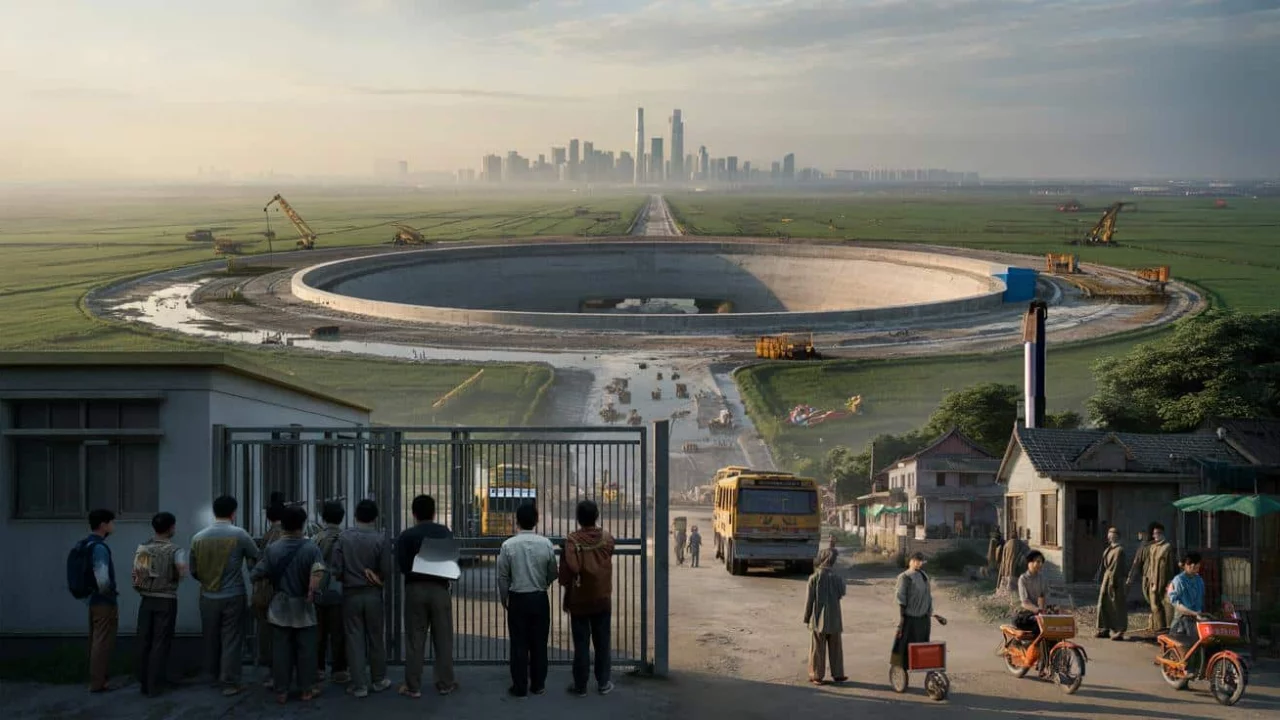
Zhang Wei stared at his laptop screen, the cursor blinking in his half-finished PhD proposal. For three years, he’d shaped his entire academic future around China’s promised particle accelerator—the world’s largest, they said. His research on quantum field interactions was tailored specifically for the Circular Electron Positron Collider that would dwarf Europe’s capabilities.
Now his advisor was suggesting he “pivot to something more practical.” The euphemism stung. Zhang refreshed the news page again, hoping the headlines would change. They didn’t.
China had just pulled the plug on what would have been the planet’s most ambitious particle accelerator, leaving thousands of researchers like Zhang scrambling to rebuild their careers around a project that no longer existed.
When Scientific Dreams Hit Economic Reality
The numbers tell a brutal story. China’s Circular Electron Positron Collider was designed to be a 100-kilometer ring of pure scientific ambition, nearly four times larger than Europe’s Large Hadron Collider. The particle accelerator would have smashed electrons and positrons together at unprecedented energies, potentially unlocking secrets about dark matter and the fundamental forces of the universe.
But ambition has a price tag, and China’s government just decided it couldn’t afford to pay it.
What started as a $5-6 billion proposal quietly ballooned into something far more expensive. Internal estimates, leaked by Chinese scientists working abroad, suggested the full program could cost upward of $20 billion once all phases were complete.
“We’re talking about building a machine that would consume more electricity than some small countries use,” explains Dr. Lisa Chen, a particle physicist who worked on early CEPC designs. “The technical challenges weren’t just about physics—they were about whether any nation should spend that much on fundamental research when people need hospitals and schools.”
The timing couldn’t have been worse. Local governments across China are still recovering from real estate crashes and pandemic-related debt. Provincial officials, who were expected to co-finance portions of the project, found themselves choosing between a underground particle accelerator and above-ground public services.
Breaking Down the Massive Costs and Competing Priorities
The financial reality of building the world’s largest particle accelerator becomes stark when you see the numbers side by side:
| Project Component | Estimated Cost | Alternative Use |
|---|---|---|
| Initial CEPC construction | $6-8 billion | 400 modern hospitals |
| Superconducting magnets | $2-3 billion | Complete rural broadband for 50 million people |
| Land acquisition & tunneling | $4-5 billion | High-speed rail connecting 20 major cities |
| Future proton collider upgrade | $8-10 billion | National pension fund for 5 years |
The competing priorities weren’t just theoretical. China faces several pressing challenges that demanded immediate financial attention:
- An aging population requiring expanded healthcare infrastructure
- Rural areas still lacking basic medical facilities
- Climate adaptation projects as extreme weather becomes more frequent
- Technology independence initiatives in semiconductors and renewable energy
- Post-pandemic economic recovery in struggling provinces
“Every yuan spent on the particle accelerator was a yuan not spent on something people could see and touch in their daily lives,” says economist Dr. Wang Ming, who advised on the project’s feasibility. “Politicians understood that villagers don’t vote based on Higgs boson research.”
The decision process revealed deep fractures within China’s scientific establishment. Senior physicists argued that abandoning the project would set China back decades in fundamental research, potentially losing an entire generation of promising scientists to European and American institutions.
What This Means for Global Science and China’s Future
The cancellation sends ripples far beyond China’s borders. Europe’s CERN facility will likely remain the world’s premier particle physics destination for at least another generation. American scientists, who had hoped Chinese competition would drive increased funding for their own projects, may find themselves making similar cost-benefit arguments to skeptical politicians.
For China’s scientific community, the impact is immediate and personal. Graduate students are scrambling to redirect their research. Post-doctoral positions that were promised at Chinese institutions are evaporating. Some researchers are already reaching out to contacts in Geneva, wondering if CERN has space for Chinese physicists with nowhere else to go.
“This wasn’t just about building a particle accelerator,” explains Dr. Sarah Johnson, who studies scientific policy at Cambridge. “It was about China’s vision of itself as a scientific superpower. Walking away from that vision says something profound about their priorities.”
The broader implications stretch into geopolitics. China’s retreat from mega-science projects might signal a shift toward more practical, economically beneficial research. Artificial intelligence, quantum computing, and green technology offer clearer paths to commercial applications and national competitive advantages.
China's decision to halt its massive particle accelerator project isn't just about physics—it's about choosing economic pragmatism over scientific prestige. A $20B reality check that even superpowers have spending limits. #Science#China
— Science Policy Watch (@SciPolicyWatch) January 15, 2024
But the decision also raises uncomfortable questions about the value of fundamental research. Particle accelerators have historically led to unexpected breakthroughs—the World Wide Web emerged from CERN, and medical imaging technologies trace their roots to particle physics research.
“We’re potentially sacrificing discoveries we can’t even imagine yet,” warns Dr. Michael Rodriguez, a theoretical physicist at Stanford. “The greatest scientific advances often come from research that seems impractical at the time.”
The Chinese government hasn’t completely abandoned scientific ambition. Funding continues to flow toward applied research in areas like fusion energy, space exploration, and biotechnology. But the particle accelerator cancellation marks a clear boundary: even China’s deep pockets have limits when public welfare competes with scientific prestige.
For students like Zhang Wei, the path forward remains uncertain. Some will pivot to fields with clearer career prospects. Others will seek opportunities abroad. A few might wait, hoping that China’s economic situation improves enough to revive the project in a decade or two.
The locked door at Beijing’s Institute of High Energy Physics remains shut for now. Behind it, empty spaces where posters once promised a scientific revolution. The dreams haven’t disappeared entirely—they’ve just gotten a lot more expensive.
FAQs
How big was China’s planned particle accelerator compared to existing ones?
China’s Circular Electron Positron Collider would have been 100 kilometers in circumference, nearly four times larger than Europe’s Large Hadron Collider at CERN.
Why did the costs increase so dramatically?
Initial estimates of $5-6 billion grew to potentially $20 billion as designs became more ambitious and included plans for future upgrades to a proton collider.
What will happen to the scientists who were working on this project?
Many graduate students and researchers are redirecting their careers toward other fields or seeking opportunities at international facilities like CERN.
Does this mean China is giving up on big science projects?
Not entirely—China continues investing in applied research areas like fusion energy, space exploration, and quantum computing that offer clearer practical benefits.
Could the project be revived in the future?
It’s possible if China’s economic situation improves and political priorities shift, but no timeline has been suggested for reconsidering the decision.
How does this affect global particle physics research?
Europe’s CERN will likely remain the world’s leading particle physics facility for the foreseeable future, potentially slowing global progress in fundamental physics research.











Leave a Comment