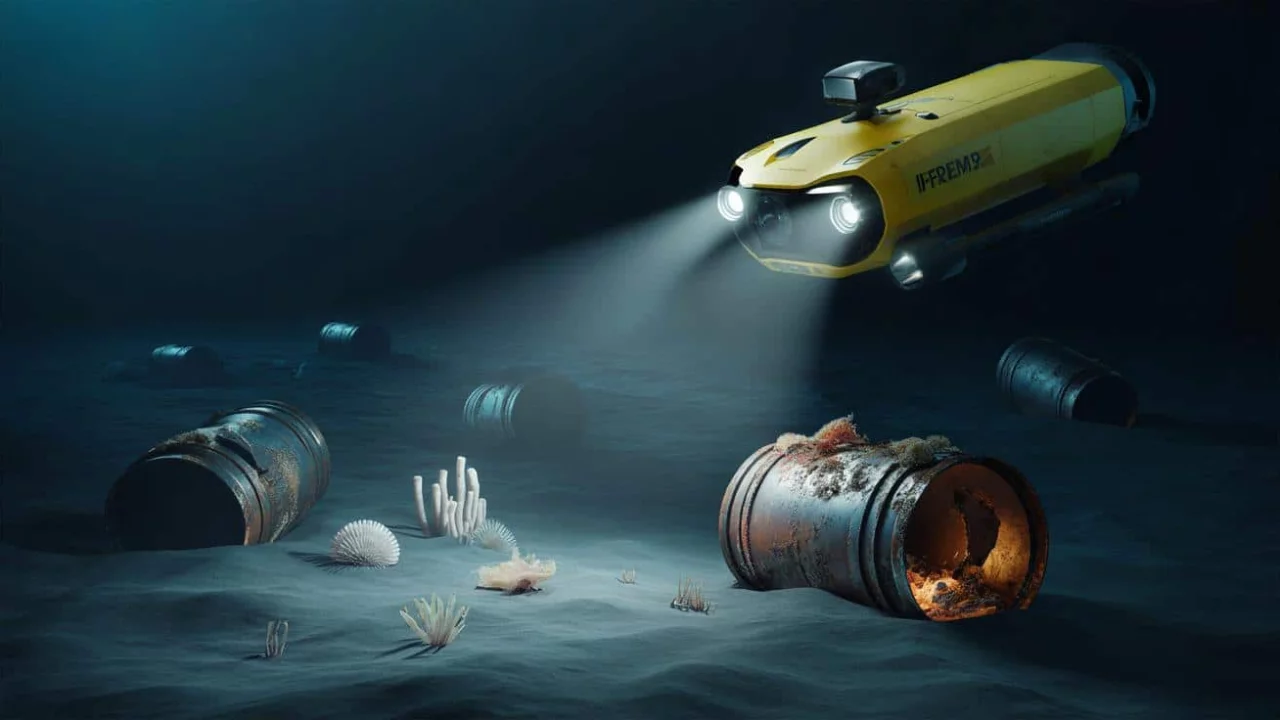
Marie Dubois still remembers the day her grandfather told her about the “secret ships” that used to leave French ports in the dead of night during the 1960s. As a young oceanographer working off the coast of Brittany, she’d always wondered what he meant by that cryptic comment. It wasn’t until decades later, when she joined a research team preparing for an unprecedented deep-sea mission, that the pieces finally clicked.
Those weren’t smuggling vessels or military operations her grandfather had witnessed. They were cargo ships carrying something far more consequential: thousands upon thousands of radioactive waste barrels destined for the deepest parts of the Atlantic Ocean.
Now, more than 40 years after the last barrel was dropped into those dark waters, French scientists are heading back down to see what became of one of the most controversial environmental decisions of the 20th century.
The Forgotten Nuclear Cemetery Beneath the Waves
Between 1949 and 1982, European nations treated the Atlantic Ocean like a cosmic trash can for nuclear waste. More than 200,000 radioactive waste barrels were systematically dropped into the northeast Atlantic by countries including France, the United Kingdom, and others.
The logic seemed bulletproof at the time: dump the low-level radioactive material in the deepest possible waters, far from any coastline, and let the ocean’s vast volume dilute any potential contamination to harmless levels. Government scientists and nuclear industry experts assured everyone that the risk was essentially zero.
“Back then, we thought the deep ocean was basically a dead zone,” explains Dr. Laurent Chauvaud, a marine biologist involved in the current research mission. “If there’s no life down there, what’s the harm in using it as storage?”
That confidence began cracking in the 1970s as environmental awareness grew. The London Convention of 1972 started restricting ocean dumping, and by 1993, the practice was banned completely. Scientists conducted monitoring missions in the 1980s and 1990s, found no obvious spikes in radioactivity, and the issue quietly faded from public conversation.
But the radioactive waste barrels never went anywhere. They’re still sitting there, 5,000 meters down, slowly aging in the crushing darkness.
Mission Nodssum: High-Tech Return to the Abyss
The new French-led expedition, called Nodssum, represents the first systematic return to these underwater dumping grounds in a generation. Funded by France’s CNRS and Ifremer research institutions, the mission focuses on a site roughly 1,000 kilometers off the coast of Brittany.
In June 2025, about 40 researchers from multiple countries boarded the research vessel L’Atalante, equipped with cutting-edge deep-sea robotics and sensing technology that would have been pure science fiction when those barrels were first dumped.
| Mission Details | Specifications |
| Depth Range | 4,700 – 5,000 meters |
| Area Covered | 163 square kilometers |
| Research Team | 40 international scientists |
| Mission Duration | Multi-year campaign |
| Primary Vessel | L’Atalante research ship |
The researchers aren’t planning to clean up the mess – that would be a technical and environmental nightmare at such depths. Instead, they want to finally answer the question that’s been haunting marine scientists for decades: what condition are those radioactive waste barrels in now, and what impact are they having on the surrounding environment?
“We’re not going down there to remove anything,” says Dr. Sophie Arnaud-Haond, a deep-sea ecologist working on the project. “We’re going down there to understand what we’re actually dealing with.”
The technology they’re bringing includes:
- Advanced remotely operated vehicles (ROVs) capable of precise maneuvering at extreme depths
- High-resolution imaging systems that can document the condition of individual barrels
- Sophisticated sensors for detecting radioactivity in water and sediment
- Biological sampling equipment to study the impact on deep-sea organisms
- Sediment corers to analyze contamination in the seabed
The Deep Ocean Isn’t Empty After All
Perhaps the biggest game-changer since those radioactive waste barrels were first dumped is our understanding of deep-sea life. For most of the 20th century, scientists assumed the abyssal plains were essentially biological deserts – cold, dark, and mostly empty.
That assumption was spectacularly wrong.
Modern biological surveys reveal thriving communities of specialized organisms perfectly adapted to the extreme conditions: tube worms that can live for centuries, slow-growing sponges, complex microbial mats, and networks of crustaceans that form the foundation of intricate food webs.
“These aren’t just random creatures scattered around the seafloor,” explains Dr. Chauvaud. “They’re interconnected ecosystems that operate on completely different timescales than anything we see on land or in shallow water.”
The problem is that these deep-sea organisms have virtually no ability to recover from disturbance. When something goes wrong in a deep-sea ecosystem, the effects can persist for decades or even centuries. Any contamination that seeps into the sediment or surrounding water doesn’t just disappear – it works its way through the food chain, potentially affecting everything from the smallest microbes to the fish that eventually make it to our dinner plates.
This revelation completely changes the risk calculation for those aging radioactive waste barrels. What seemed like a harmless disposal method in the 1960s now looks like a potential ecological time bomb.
“We’re dealing with ecosystems that think in geological time,” notes Dr. Arnaud-Haond. “A disturbance that seems minor to us could be catastrophic for organisms that live for hundreds of years and reproduce incredibly slowly.”
The researchers are particularly concerned about the metal barrels themselves. After more than 40 years in corrosive seawater under immense pressure, many of these containers are likely compromised. The question isn’t whether they’ll eventually leak – it’s whether they already are, and what that means for the surrounding environment.
French scientists are heading back to check on 200,000 radioactive waste barrels dumped in the Atlantic decades ago. The deep-sea technology they’re using would have been pure science fiction when those barrels were first dropped 5km down. https://t.co/example
— Ocean Research Network (@OceanResearch) January 15, 2025
The mission could also provide crucial data for similar situations worldwide. The Atlantic dumping grounds aren’t unique – other countries made similar decisions during the Cold War era, creating underwater nuclear waste sites in the Pacific and Arctic oceans.
“What we learn from this mission won’t just tell us about these specific barrels,” says Dr. Chauvaud. “It’ll help us understand the long-term consequences of decisions made when we knew a lot less about how the ocean actually works.”
The results of the Nodssum mission won’t just be academic. They could influence everything from international environmental law to how we handle nuclear waste disposal in the future. More immediately, they might finally answer whether the radioactive waste barrels represent an ongoing threat to marine ecosystems and, potentially, human food sources.
As Marie Dubois and her colleagues prepare their deep-sea robots for the journey down to those forgotten barrels, they’re carrying the weight of decades of unanswered questions. The deep ocean may have been treated as humanity’s ultimate garbage disposal, but it turns out the ocean has been keeping track of everything we threw away.
Now it’s time to face the bill.
FAQs
Why were radioactive waste barrels dumped in the ocean in the first place?
Between 1949 and 1982, governments believed the deep ocean was lifeless and that the vast volume of water would safely dilute any radioactivity to harmless levels.
How many radioactive waste barrels are down there?
More than 200,000 barrels of low-level radioactive waste were dropped into the northeast Atlantic by European countries over 33 years.
Are the scientists planning to clean up the barrels?
No, removing the barrels from 5,000 meters depth would be technically extremely difficult and could cause more environmental damage than leaving them alone.
What’s different about this mission compared to previous checks?
Modern scientists have much better deep-sea technology and understand that the deep ocean hosts complex, fragile ecosystems rather than being empty and lifeless.
Could the radioactive waste affect fish we eat?
That’s one of the key questions the mission hopes to answer by studying how any contamination moves through deep-sea food chains.
When will we know the results?
The Nodssum mission is a multi-year campaign that began in June 2025, so initial findings should emerge over the next several years.











Leave a Comment