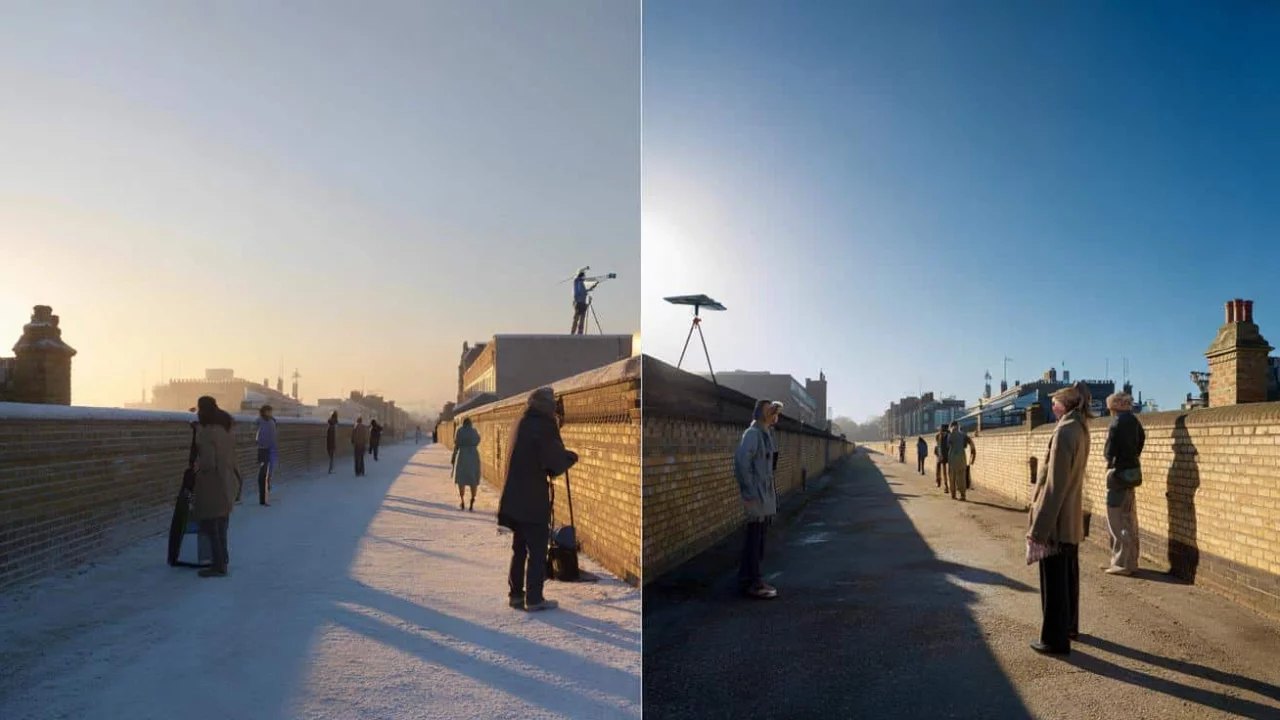
Sarah stepped out of her London flat at 8am, shivering in her thin jacket. The Sun was already up, casting long golden rays across the pavement, but the air felt sharp against her skin. “Strange,” she thought, “it looks so sunny.” By 2pm, walking the exact same street, she found herself peeling off layers as sweat beaded on her forehead. The weather app showed barely a degree difference between morning and afternoon.
Like Sarah, millions of people experience this daily puzzle without understanding the simple physics behind it. The answer isn’t mysterious weather patterns or faulty thermometers. It’s geometry—specifically, how sunlight angles change throughout the day and dramatically affect the temperature we feel.
Scientists have spent decades studying this phenomenon, and their findings reveal why the same Sun can feel completely different from one hour to the next. The secret lies in understanding how the angle of solar radiation determines how much energy actually reaches the ground beneath our feet.
Why Sunlight Angles Control Your Daily Temperature
When researchers measure solar radiation throughout the day, they discover something remarkable. The same amount of sunlight can produce vastly different heating effects based purely on the angle at which it strikes the Earth’s surface.
Dr. Michael Chen, a solar physicist at the National Weather Service, explains it simply: “Think of sunlight like water from a garden hose. Spray it straight down and you get a concentrated, powerful stream. Tilt the hose at a shallow angle and the same water spreads out weakly over a much larger area.”
This analogy perfectly captures how sunlight angles work. When the Sun sits low on the horizon during early morning or late evening, its rays hit the ground at a shallow angle. The solar energy gets “smeared” across a much larger surface area, delivering less heat per square meter. As the Sun climbs higher, reaching its peak around noon, the rays strike more directly, concentrating energy into smaller areas and producing rapid warming.
The numbers are striking. Satellite measurements show that surfaces can receive three times more solar energy at high sun angles compared to low angles, even though the Sun’s total output remains constant.
The Science Behind Your Daily Temperature Experience
Understanding sunlight angles reveals why your morning coffee feels perfect at 9am but you’re reaching for iced drinks by 3pm. Here are the key factors that create this daily temperature transformation:
- Surface heating lag: The ground absorbs heat faster than air, creating a delay between peak sun angle and peak air temperature
- Energy concentration: High-angle sunlight delivers 200-300% more energy per square meter than low-angle rays
- Thermal storage: Concrete, asphalt, and buildings store heat during peak sun hours and release it slowly
- Atmospheric filtering: Low-angle sunlight travels through more atmosphere, reducing intensity
The thermal lag effect explains why the hottest part of the day typically occurs between 2pm and 4pm, well after the Sun reaches its highest point around noon. “The atmosphere is like a giant heat sink,” notes Dr. Rebecca Martinez, a climate researcher at the University of Colorado. “It takes time to absorb and redistribute all that concentrated solar energy.”
| Time of Day | Sun Angle | Energy Intensity | Temperature Effect |
|---|---|---|---|
| 8am | Low (15-30°) | Weak, spread out | Cool, crisp air |
| 12pm | High (60-90°) | Strong, concentrated | Rapid surface heating |
| 3pm | Medium (45-70°) | Moderate, direct | Peak air temperature |
| 6pm | Low (15-40°) | Weak, angled | Cooling begins |
How This Knowledge Changes Your Daily Life
Understanding sunlight angles gives you a superpower: the ability to predict how the day will feel based on sun position rather than just checking the weather app. This knowledge affects everything from choosing workout times to planning outdoor events.
Professional athletes have long understood this principle. Tennis players know that morning matches in direct sunlight can still feel cool, while afternoon games become grueling even with lower sun angles. Construction workers schedule the most demanding tasks for early morning hours, before high-angle sunlight turns job sites into furnaces.
“I used to rely entirely on temperature forecasts,” says Mark Thompson, a landscaping contractor in Phoenix. “Now I look at sun angle charts. It’s completely changed how I schedule my crew’s work day. We can be productive hours longer just by understanding when the real heat hits.”
The principle applies to energy costs too. Homes with large south-facing windows experience dramatic temperature swings based on sun angles. Low winter sun penetrates deep into rooms, providing natural heating. High summer sun, blocked by proper overhangs, keeps interiors cooler.
Even your commute becomes more predictable. That shaded parking spot feels perfect at 8am but becomes an oven by 3pm when high-angle sunlight penetrates areas that seemed protected during low-angle morning hours.
Urban planners increasingly factor sunlight angles into city design. Street orientation, building heights, and park placement all consider how sun angles affect pedestrian comfort throughout the day. Cities like Barcelona and Portland have redesigned public spaces specifically to optimize shade during high-angle sun periods while maximizing warming during low-angle hours.
Dr. Jennifer Liu, an urban climate specialist, puts it in perspective: “We’re finally designing cities around the Sun’s geometry instead of fighting against it. When you understand sunlight angles, you can create spaces that work with natural heating and cooling patterns.”
Ever wonder why 70°F feels different at 9am vs 3pm? It's all about sun angle! Low morning sun spreads energy thin, high afternoon sun concentrates heat. Same temperature, completely different thermal experience. 🌅☀️ #SolarScience
— Weather Underground (@wunderground) March 15, 2024
The next time you step outside and feel confused by why the temperature doesn’t match how the weather actually feels, remember Sarah’s morning walk. Look at your shadow. If it’s long and stretches far ahead of you, the Sun’s energy is spread thin and temperatures will likely stay moderate. If your shadow is short and tucked close beneath your feet, prepare for concentrated solar heating that will warm the air around you within hours.
This simple geometry governs not just your daily comfort, but seasonal climate patterns, agricultural growing seasons, and even the design of solar panel installations. The Sun hasn’t changed, but our understanding of how its angles affect our daily lives continues to reveal new insights about the world around us.
FAQs
Why does the same temperature feel different at different times of day?
Sunlight angles change how much solar energy reaches your skin and surrounding surfaces, making the same air temperature feel warmer or cooler depending on sun position.
What time of day does the Sun’s angle create the most heating?
Between 10am and 2pm when the Sun is highest, creating the most direct, concentrated solar radiation on surfaces.
Why is afternoon often hotter than noon even though the Sun is lower?
Thermal lag means surfaces continue absorbing and releasing heat for hours after peak sun angle, causing maximum air temperatures in mid-afternoon.
How can I use sunlight angles to plan my day?
Check your shadow length – long shadows mean spread-out, weaker solar energy; short shadows indicate concentrated heating is coming.
Do sunlight angles affect indoor temperatures too?
Yes, especially in rooms with large windows where direct sunlight can raise indoor temperatures significantly during high sun angle periods.
Why do winter days feel cold even when sunny?
Low winter sun angles spread the same solar energy over much larger areas, providing less heating per square meter compared to high summer sun.











Leave a Comment