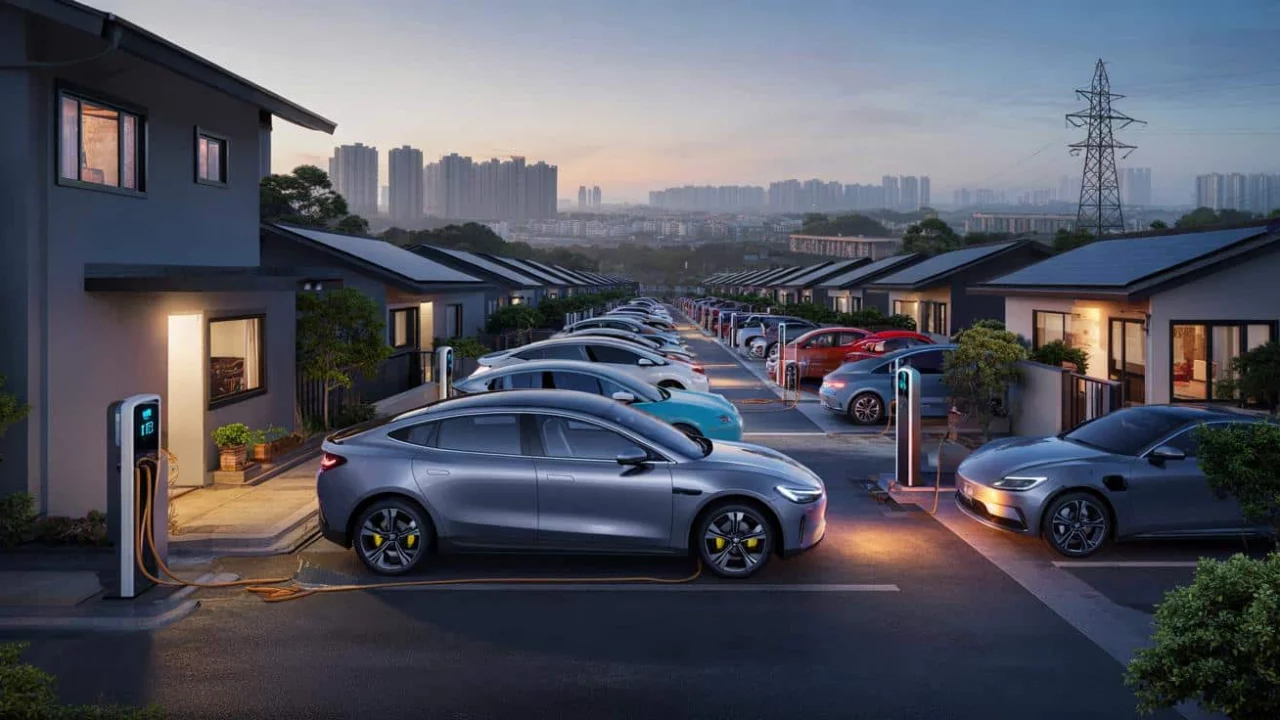
Zhang Wei plugs in his BYD electric car every night after his commute home to Shanghai. But lately, something interesting has been happening. Instead of just charging up and sitting idle, his car has started earning him money while he sleeps. On particularly hot summer days, when the city’s air conditioners strain the power grid, his vehicle quietly feeds electricity back into the system.
Last month, Zhang earned 800 yuan – about $110 – just from letting his parked car help power his neighborhood. “It’s like having a part-time job that requires no effort,” he laughs. “My car works the night shift now.”
Zhang isn’t alone. Across China, millions of electric vehicle owners are about to discover that their cars can do much more than just get them from point A to point B.
How China’s Electric Cars Became Mobile Power Plants
China has stumbled onto something remarkable. With over 40 million electric vehicles already cruising its streets, the country now has what amounts to the world’s largest distributed battery network. The twist? Most owners don’t even realize it yet.
The magic happens through something called vehicle-to-grid technology, or V2G for short. Think of it as turning your car’s charging relationship with the electrical grid into a two-way conversation. Instead of just taking power, your EV can give it back when needed.
“We’re essentially creating millions of mini power plants that happen to have wheels,” explains Dr. Liu Chen, an energy systems researcher at Beijing University of Technology. “Each parked car becomes a node in a massive energy storage network.”
Here’s how it works in practice. During off-peak hours – typically late at night when electricity is cheap and abundant – your car charges up as usual. But when demand spikes during the day, especially during those sweltering summer afternoons when everyone cranks up their air conditioning, your car can reverse the flow and send power back to the grid.
The numbers are starting to look impressive. Early pilot programs show drivers earning up to 1,400 yuan (about $195) for a complete discharge session. That’s enough to cover a month’s worth of groceries for many families.
The Massive Scale of China’s Vehicle-to-Grid Ambitions
Right now, only about 30 bidirectional charging stations exist across nine Chinese cities. But Beijing’s plans are nothing if not ambitious. The government wants to scale this up fast.
| Timeline | Target | Impact |
|---|---|---|
| 2024 (Current) | 30 stations in 9 cities | Pilot testing phase |
| 2027 | 5,000 bidirectional stations | Regional grid support |
| 2030 | 1 billion kilowatt capacity | National grid integration |
That 2030 target deserves some perspective. One billion kilowatts is roughly equivalent to the output of several large nuclear power plants. Except instead of being concentrated in one location, this power source would be scattered across millions of parking spots, driveways, and charging stations throughout the country.
The key advantages of vehicle-to-grid technology include:
- Instant response to grid emergencies – cars can start feeding power back within seconds
- Distributed storage that’s harder to disrupt than centralized power plants
- Natural load balancing as people charge at different times
- Integration with renewable energy sources like solar and wind
- Revenue generation for EV owners
“The beauty of this system is that it uses infrastructure we’re already building,” notes energy analyst Wang Xiaoming from the China Electric Vehicle Association. “Every new EV on the road potentially adds to our grid storage capacity.”
The timing couldn’t be better. China’s renewable energy sector is booming, but wind and solar power are notoriously unpredictable. Vehicle-to-grid technology offers a way to store excess clean energy when it’s abundant and release it when the wind isn’t blowing or the sun isn’t shining.
What This Means for Families and Communities
For ordinary Chinese families, this represents a fundamental shift in how they think about their vehicles. Your car stops being just a transportation expense and becomes a potential income source.
Take the Chen family from Shenzhen. They bought their electric SUV last year primarily to avoid the city’s license plate lottery for gas-powered vehicles. Now they’re looking at vehicle-to-grid technology as a way to offset their monthly car payments.
“If I can earn 500 yuan per month just by parking my car and plugging it in, that covers most of my charging costs,” says Chen Ming, a software engineer. “It’s like the car pays for itself.”
The broader implications stretch beyond individual bank accounts. Grid operators see this as a solution to one of their biggest headaches: peak demand management. Instead of firing up dirty coal plants during electricity crunches, they can tap into the stored energy sitting in millions of parked cars.
This approach offers several benefits for communities:
- Reduced risk of blackouts during extreme weather events
- Lower overall electricity costs as peak demand becomes more manageable
- Cleaner air as fewer backup coal plants need to operate
- More stable integration of renewable energy sources
“We’re moving toward a future where every neighborhood has its own distributed battery backup,” explains grid management expert Dr. Zhang Hui. “Your parked EV could literally keep your neighbor’s lights on during a power emergency.”
The technology also promises to make electric vehicle ownership more attractive. As vehicle-to-grid systems mature, the monthly payments EV owners receive could significantly reduce their total cost of ownership, making electric cars an even more compelling choice over traditional gasoline vehicles.
China's vehicle-to-grid pilot programs are showing remarkable results. EV owners earning up to $195 per discharge cycle while helping stabilize the national power grid. This could be the breakthrough that makes EVs profitable even when parked. #V2G#ElectricVehicles
— Clean Energy News (@CleanEnergyNews) March 15, 2024
Of course, challenges remain. The technology requires specialized bidirectional chargers, which are more expensive than standard units. There are also concerns about battery degradation from frequent charging and discharging cycles, though modern EV batteries are proving more resilient than early estimates suggested.
But as China’s pilot programs expand and the technology matures, vehicle-to-grid systems could fundamentally reshape how we think about both transportation and energy. Your next car might not just take you places – it might help power the journey.
FAQs
How much money can EV owners actually make from vehicle-to-grid technology?
Current pilot programs in China show earnings of up to 1,400 yuan ($195) per full discharge session, with monthly earnings potentially reaching 500-800 yuan for regular participants.
Does using my car as a grid battery damage the vehicle’s battery?
Modern EV batteries are designed to handle thousands of charge cycles, and vehicle-to-grid systems typically use only a portion of the battery’s capacity, minimizing wear and extending overall battery life.
What equipment do I need to participate in vehicle-to-grid programs?
You need an electric vehicle with bidirectional charging capability and access to a V2G charging station, which allows electricity to flow both to and from your car’s battery.
When will vehicle-to-grid technology be available in other countries?
Several countries including Japan, South Korea, and parts of Europe are testing similar programs, but China’s scale and rapid deployment timeline make it the current global leader in V2G implementation.
How does the grid know when to take power from my car?
Smart grid systems automatically manage energy flow based on real-time demand, typically drawing from vehicle batteries during peak hours and charging them when demand is low, usually overnight.
Can I still drive my car if it’s participating in grid programs?
Yes, V2G systems are designed to maintain enough battery charge for your daily driving needs, and you can override the system anytime you need to use your vehicle.











Leave a Comment