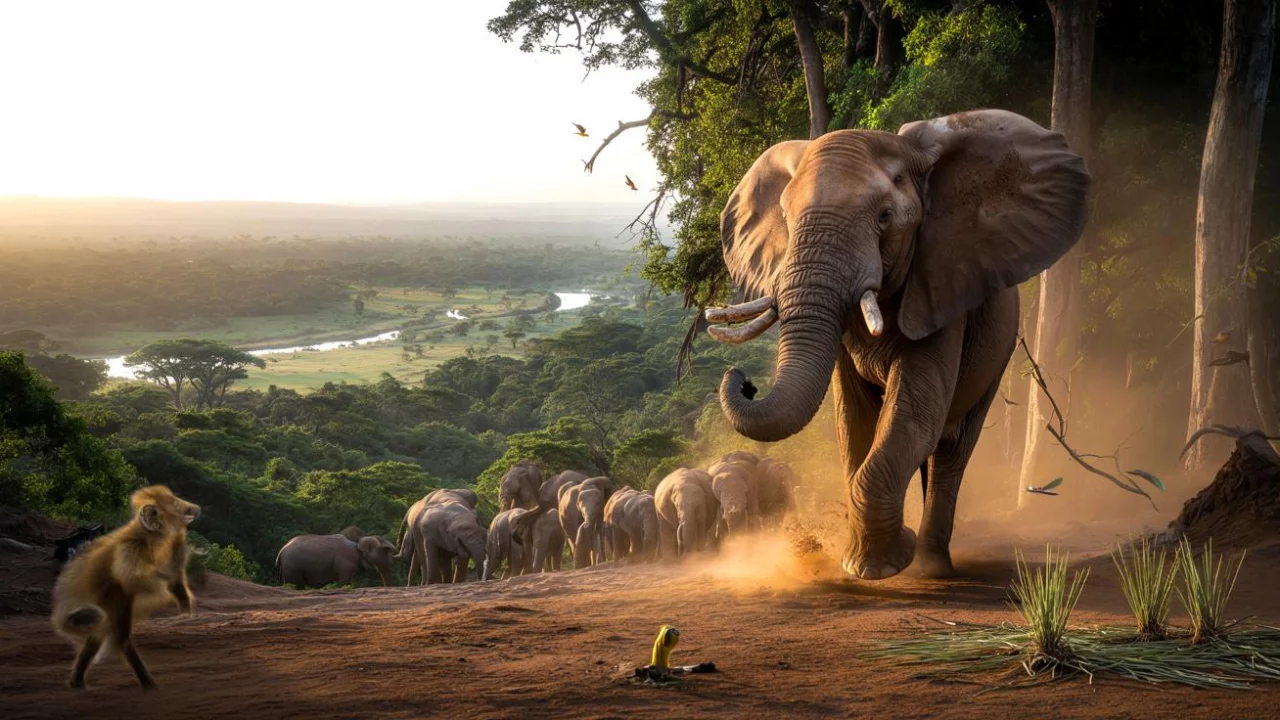
Sarah Chen first noticed something strange while reviewing satellite images from her office in Nairobi. The dense green canopy of the Congo Basin had tiny gaps scattered throughout—not from logging or fires, but from something else entirely. When she zoomed in closer, the pattern became clear: pathways winding through the forest like a natural highway system. “I thought our equipment was glitching,” she laughs, adjusting her glasses. “Then I realized we were looking at elephant roads.”
What Sarah discovered that day changed how she thinks about conservation. Those gaps weren’t signs of destruction—they were proof of one of nature’s most remarkable engineering projects. More than 100,000 African elephants protected across the continent are quietly rebuilding entire landscapes, one footstep at a time.
For decades, we’ve focused on saving elephants from extinction. Now scientists are discovering that these massive creatures don’t just need protection—they’re actively reshaping the world around them in ways that benefit countless other species.
The World’s Largest Landscapers Are Back to Work
Picture walking behind a forest elephant for just ten minutes. You’d quickly realize you’re not following an ordinary animal—you’re watching a living bulldozer, gardener, and seed distribution center all rolled into one six-ton package.
Dr. Marcus Williams, who has tracked elephant herds in Gabon for eight years, puts it simply: “They’re not just surviving anymore. They’re rebuilding the forest from the ground up.” When elephants push through dense vegetation, they create corridors that become highways for other animals. Monkeys use these paths to travel between feeding areas. Antelope follow the cleared routes to water sources. Even tiny forest birds benefit from the increased light filtering through the canopy.
The numbers tell an incredible story. Recent surveys across protected areas in Central and West Africa show elephant populations stabilizing and even growing in some regions. In Gabon’s national parks alone, researchers estimate over 50,000 forest elephants now roam freely—double the number from a decade ago.
But here’s what makes this story remarkable: every single elephant acts as a mobile ecosystem engineer. They knock down young trees that crowd out sunlight, allowing forest giants to grow taller. They trample thick undergrowth, creating clearings where new plant species can take root. Most importantly, they carry seeds in their stomachs for days before depositing them miles away, essentially planting new forests with every meal.
The Hidden Science Behind Elephant Engineering
The data from protected elephant populations reveals fascinating patterns about how these animals reshape their environment:
| Elephant Impact | Forest Change | Benefit to Ecosystem |
|---|---|---|
| Path Creation | 3-5 meter wide corridors | Travel routes for 200+ species |
| Seed Dispersal | 30-60 km range per day | Genetic diversity across forests |
| Tree Thinning | 40% reduction in small trees | More light for forest floor |
| Soil Fertilization | 300 kg of dung daily per elephant | Nutrient cycling throughout ecosystem |
“What we’re seeing is unprecedented,” explains Dr. Amara Okafor, a forest ecologist working in Cameroon. “Protected elephants are essentially rewilding landscapes faster than we ever thought possible.”
The seed dispersal alone is staggering. A single elephant can carry seeds from over 80 different plant species in its digestive system. Unlike smaller animals that drop seeds close to parent trees, elephants travel vast distances before depositing their natural cargo. This creates genetic diversity that makes forests more resilient to climate change and disease.
Key ecosystem services provided by protected African elephants include:
- Creating water access points for drought-prone regions
- Maintaining forest clearings that prevent catastrophic wildfires
- Dispersing seeds for fruit trees that feed hundreds of animal species
- Opening dense canopy to allow diverse plant growth on forest floors
- Creating mineral-rich wallows that become gathering spots for wildlife
Recent carbon sequestration studies add another layer to this story. Forests shaped by elephants actually store more carbon than untouched areas because the elephants promote the growth of larger, longer-living trees while clearing out competing vegetation.
Real Communities Feel the Difference
The impact of these ecosystem engineers extends far beyond the forest. In rural communities across Africa, people are noticing changes that directly affect their daily lives.
Take the village of Mbandaka in the Democratic Republic of Congo. Local farmer Jean-Baptiste Mokoko says the return of elephants to nearby protected areas has transformed the landscape around his community. “The forest is different now,” he explains. “More fruit trees, clearer paths to our fields, even new water sources we never had before.”
Tourism revenue from elephant watching has also increased dramatically in regions where populations have recovered. Kenya’s Amboseli National Park, home to over 1,600 protected elephants, generates more than $100 million annually from visitors who come specifically to see these landscape architects at work.
Dr. Williams points out another crucial benefit: “Elephants are creating climate refuges. Their forest clearings provide cooler microclimates that other species use during increasingly hot dry seasons.”
The ripple effects reach into agriculture as well. Elephant-modified landscapes show increased pollinator activity, which benefits crop yields in surrounding areas. Farmers report better harvests of coffee, cocoa, and fruit trees in regions where elephant populations have stabilized.
However, human-elephant conflict remains a challenge. As populations recover, elephants occasionally raid crops or damage property. Conservation groups are responding with innovative solutions like bee-hive fences and early warning systems that alert communities when herds are approaching.
The success of protecting over 100,000 African elephants represents more than just species conservation—it’s proof that large-scale ecosystem restoration is possible. These gentle giants are showing us that sometimes the best way to heal damaged landscapes is to step back and let nature’s engineers do what they do best.
What started as an effort to save elephants from extinction has become one of the most effective landscape restoration projects on Earth. Every protected herd represents thousands of trees that will be planted, hundreds of animal corridors that will be created, and entire ecosystems that will be rebuilt—all without human intervention, just elephants doing what elephants have always done best.
FAQs
How many African elephants are currently protected?
More than 100,000 African elephants now live in protected areas across the continent, with populations stabilizing in many regions.
How do elephants help spread seeds?
Elephants eat fruits and carry seeds in their digestive systems for days, depositing them up to 60 kilometers away from the parent plant.
Do elephant paths really help other animals?
Yes, over 200 species use elephant-created corridors for travel, including monkeys, antelope, and forest birds.
Are elephant-modified forests better for the environment?
Studies show elephant-shaped forests store more carbon, have greater biodiversity, and are more resilient to climate change.
What challenges remain for elephant conservation?
Human-elephant conflict and habitat loss are ongoing issues, though innovative solutions like bee-hive fences are showing promise.
How much dung does an elephant produce daily?
A single elephant produces about 300 kilograms of dung per day, which acts as natural fertilizer throughout the ecosystem.











Leave a Comment