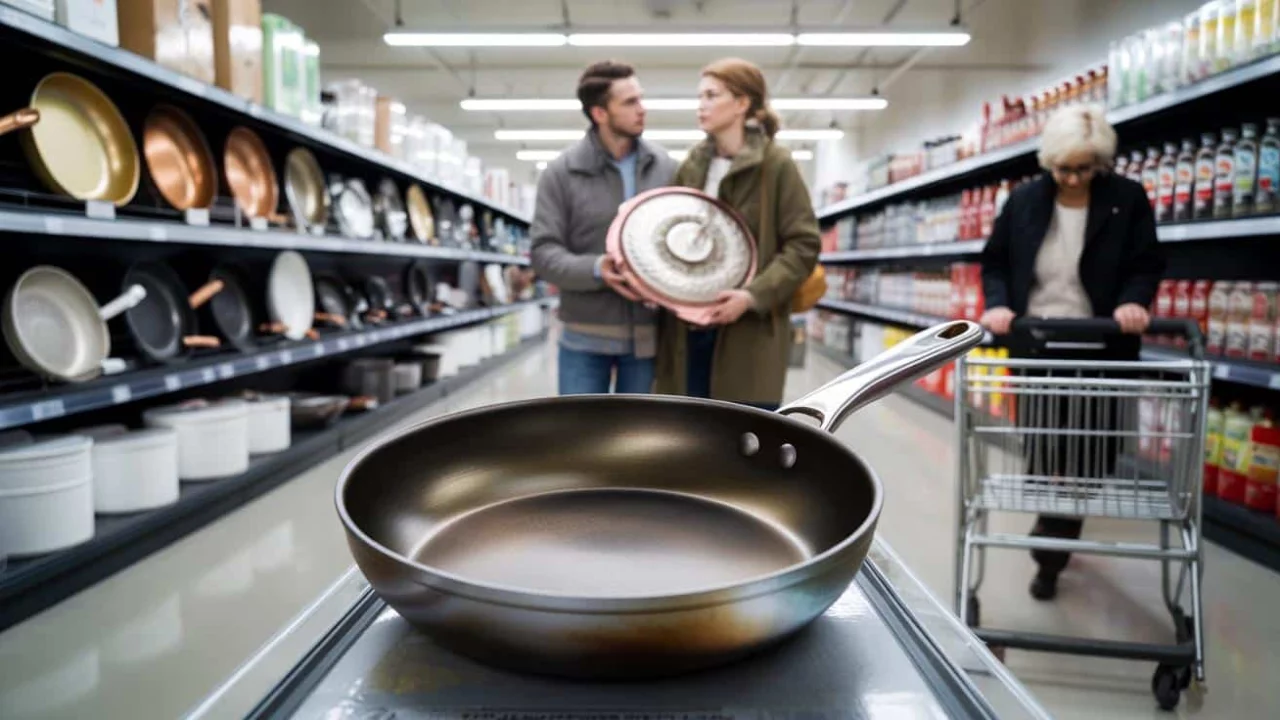
The frying pans were all lined up under the fluorescent lights, like soldiers waiting for inspection. Shiny copper, sleek black non-stick, heavy cast iron that looked like it belonged in a mountain cabin. A young couple hesitated between a €90 “healthy ceramic” model and a €19 steel pan that looked almost boring in comparison. The sales label shouted “non-toxic coating,” “stone effect,” “latest generation.” The cheap steel pan didn’t shout anything. It just sat there, slightly dull, reassuringly heavy, with no marketing claims taped to its handle.
They hesitated. Then they grabbed the expensive one.
An older woman next to them quietly slipped the €19 steel pan into her cart and walked away. She probably just chose the healthiest frying pan in the aisle.
Why the plainest pan might be your safest bet
If you ask ten people which pan is healthiest, most will point to something with a shiny coating and a wellness-friendly label. We’ve been conditioned to associate “non-stick” with “good for you,” as if easy cleaning meant safe cooking. Yet in most nutrition and toxicology circles, the answer that keeps coming back sounds almost disappointingly simple: a plain carbon steel or stainless steel pan, without fancy chemical coatings.
No marble effect, no rainbow layer, no miracle surface. Just metal, heat, and food.
“When patients ask me about cookware safety, I always tell them the same thing,” says Dr. Maria Santos, a food safety researcher at the European Food Safety Authority. “The healthiest frying pan is often the one that doesn’t promise to be healthy at all.”
Here’s what makes steel pans stand out: they don’t rely on chemical compounds to prevent sticking. They don’t have synthetic coatings that can break down at high temperatures. When you cook with steel, you’re literally just heating metal. No PFOA, no PTFE, no ceramic particles that might chip off into your scrambled eggs.
The marketing industry has done such a good job convincing us that cooking needs to be effortless that we’ve forgotten something basic: food can stick to a pan and still be perfectly safe to eat. Our grandparents cooked with cast iron and steel for decades without worrying about toxic fumes or coating degradation.
Breaking down the health claims and real risks
Walk through any kitchen store today and you’ll see labels that read like medical prescriptions. “Chemical-free!” “Safe up to 500°F!” “Toxin-resistant!” But when you dig deeper into what makes a frying pan truly safe for daily cooking, the picture gets clearer.
Non-stick coatings, even the newer ceramic and diamond-infused versions, all share one fundamental weakness: they’re designed to break down over time. That’s not a bug, it’s a feature. The companies that make them want you to replace your pans every two to three years.
| Pan Type | Average Cost | Main Health Concerns | Lifespan |
|---|---|---|---|
| Non-stick (PFOA/PTFE) | €40-120 | Toxic fumes at high heat, coating degradation | 2-3 years |
| Ceramic coating | €60-150 | Coating chips, possible heavy metals | 2-4 years |
| Carbon steel | €15-35 | Minimal (iron absorption) | 20+ years |
| Stainless steel | €25-80 | Minimal (trace nickel) | 15+ years |
“The safest cookware is the kind that doesn’t change composition when you heat it,” explains chef and food safety consultant James Chen. “Steel pans don’t off-gas, don’t flake, and don’t need special temperature limits.”
The key benefits of choosing steel over coated pans include:
- No chemical coatings to deteriorate or release particles
- Can handle any temperature your stove can produce
- Actually improve with age as they develop natural non-stick properties
- Don’t require special utensils or gentle cleaning methods
- Can go from stovetop to oven without worry
- Cost a fraction of premium “healthy” alternatives
The learning curve isn’t as steep as marketing would have you believe. Yes, you need to use more oil or butter. Yes, you might have some sticking at first. But after a few weeks of regular use, a steel pan develops a natural patina that rivals many non-stick surfaces.
What this means for your kitchen and wallet
The financial math alone makes steel pans compelling. A good carbon steel pan costs around €20-30 and can last decades with proper care. Compare that to replacing a €100 ceramic non-stick pan every three years, and you’re looking at significant savings over time.
But the health implications go deeper than just avoiding chemical exposure. When you cook with steel, you’re also getting trace amounts of iron in your food – which can actually be beneficial for people with iron deficiency. It’s a far cry from worrying about PFOA accumulation or ceramic particles.
“I’ve been using the same carbon steel pan for eight years now,” says home cook Sarah Martinez from Barcelona. “It’s become more non-stick over time, not less. Meanwhile, I’ve watched friends go through three different ‘healthy’ pans in the same period.”
The environmental impact tells a similar story. Steel pans don’t need complex chemical processes to manufacture. They don’t create toxic waste when disposed of. They don’t need frequent replacement. From a sustainability standpoint, they’re about as clean as cookware gets.
For families with children, the peace of mind factor can’t be overstated. You never have to worry about overheating a steel pan and creating toxic fumes. You don’t need to throw it away the moment you see a scratch. Kids can help cook without you worrying about them damaging a delicate coating.
The only real downside is the initial adjustment period. If you’re used to everything sliding around effortlessly, steel pans require a bit more technique. You need to heat them properly, use adequate fat, and develop a feel for when food is ready to flip.
But ask anyone who’s made the switch, and most will tell you the same thing: once you get used to cooking with steel, going back to coated pans feels like cooking with training wheels.
FAQs
Do steel pans really become non-stick over time?
Yes, with regular use and proper seasoning, steel pans develop a natural non-stick surface that improves with age.
Are there any health risks with steel cookware?
Minimal. Carbon steel can add trace iron to food, which is usually beneficial. Stainless steel may release tiny amounts of nickel, but well below harmful levels.
How do I prevent food from sticking in a steel pan?
Heat the pan properly before adding oil, use enough fat, and don’t move food too early. Most sticking happens from impatience.
Which is better for health: carbon steel or stainless steel?
Both are excellent choices. Carbon steel develops better non-stick properties, while stainless steel requires no seasoning maintenance.
Can I put steel pans in the dishwasher?
Stainless steel yes, carbon steel no. Carbon steel should be hand-washed and dried immediately to prevent rust.
How long do steel pans actually last?
With proper care, decades. Many people pass down steel and cast iron pans through generations.










Leave a Comment