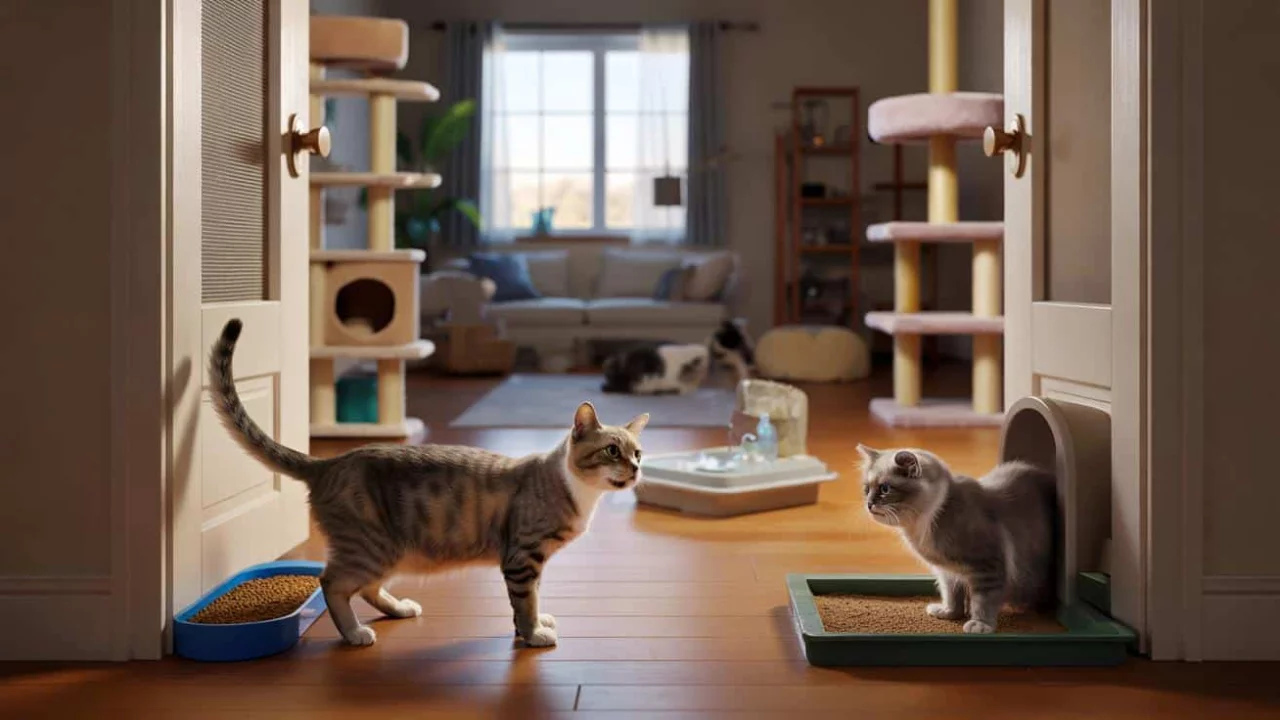
Sarah thought her two cats were perfect together until last Tuesday morning. She woke up to find Mochi cornered in the bathroom, too terrified to come out for food, while Luna sat guard at the doorway like a furry bouncer. What had been playful wrestling just days before had turned into something that made Sarah’s stomach drop with worry.
The scratches on Mochi’s nose told the real story. This wasn’t normal cat behavior anymore—this was a household at war.
If you’re reading this with your own heart sinking because your cats have suddenly become enemies, you’re not alone. Thousands of cat parents watch their peaceful multicat household explode into chaos, wondering where they went wrong and whether they’ll need to rehome one of their beloved pets.
When playful swats turn into real warfare
Every multicat household has its moments of tension. Cats hiss over the best sleeping spot, chase each other around furniture, and occasionally have dramatic standoffs that end with both animals walking away with their dignity intact.
But something shifts when one cat starts controlling the other’s entire life. You’ll see it in small, heartbreaking details: one cat refusing to eat unless the other is locked away, a previously social cat spending entire days hiding under the bed, or constant stalking that never lets up.
“When cats can’t access basic resources like food, water, or their litter box without fear, we’ve moved beyond normal social dynamics into genuine distress,” explains animal behaviorist Dr. Jennifer Martinez.
The warning signs in a multicat household often develop gradually, then suddenly become impossible to ignore:
- One cat blocking access to food bowls, water dishes, or litter boxes
- Silent stalking followed by surprise attacks
- A cat refusing to enter certain rooms where the aggressor might be waiting
- Stress-related behaviors like excessive grooming, loss of appetite, or inappropriate elimination
- Constant vigilance where one cat never seems to relax
The hidden triggers that destroy cat relationships
Most cat fights don’t start from nowhere. Something usually changes in your multicat household that tips the delicate balance these territorial animals maintain.
Medical issues top the list of unexpected triggers. A cat dealing with arthritis pain, dental problems, or a urinary tract infection becomes irritable and defensive. When the other cat approaches during a painful moment, the sick cat lashes out—and suddenly, both animals remember each other as a threat.
Environmental stressors hit multicat households particularly hard. Moving to a new home, construction noise, new furniture, or even a different brand of litter can create enough anxiety to spark territorial disputes. Cats also pick up on human stress, so family tensions, work pressure, or major life changes can ripple through your pet dynamics.
| Common Triggers | How They Affect Cat Relationships | Solutions |
|---|---|---|
| Medical pain | Creates defensive, aggressive responses | Vet checkups for both cats immediately |
| Resource competition | Escalates territorial behavior | Multiple feeding stations, extra litter boxes |
| Redirected aggression | Frustration at outside cats gets taken out on housemates | Block views of outdoor cats, increase enrichment |
| Stress from changes | Disrupts established social hierarchy | Gradual transitions, pheromone diffusers |
“The most common mistake I see is owners assuming their cats are just being mean to each other,” notes veterinary behaviorist Dr. Rachel Chen. “Usually, there’s an underlying cause that we can address once we identify it.”
Redirected aggression deserves special attention in multicat households. This happens when your indoor cat sees a strange cat outside the window, gets frustrated because they can’t chase it away, and then turns that aggressive energy on their housemate instead. What should have been directed at the outdoor intruder gets dumped on the innocent cat who happened to walk by at the wrong moment.
Practical steps that actually restore peace
Before you start planning to rehome one of your cats, several proven strategies can rebuild a harmonious multicat household. The key is creating enough physical and emotional space for both cats to feel secure again.
Start with complete separation. This isn’t punishment—it’s giving both cats a chance to decompress without the constant stress of conflict. Set up separate territories in your home with their own food, water, litter boxes, and comfortable spaces. Each cat needs to feel like they have a safe zone where the other can’t intrude.
The resource multiplication strategy works wonders in most multicat households. Follow the “N+1” rule: if you have two cats, provide three litter boxes, three water stations, and multiple feeding areas. Place these resources throughout your home so neither cat can guard all of them at once.
“Environmental enrichment can redirect competitive energy into healthier outlets,” explains feline specialist Dr. Amanda Lopez. “When cats have plenty of vertical space, hiding spots, and mental stimulation, they’re less likely to focus their frustrations on each other.”
Gradual reintroduction takes patience but often saves multicat households from permanent separation. Start by feeding both cats on opposite sides of a closed door, so they associate each other’s presence with positive experiences. Slowly increase their exposure through controlled visual contact, always watching their body language and backing off if tension builds.
Pheromone diffusers and calming supplements can provide the extra support some cats need during the reconciliation process. These tools don’t solve behavioral problems on their own, but they can reduce overall anxiety levels enough for other interventions to work.
Sometimes professional help makes all the difference. A certified cat behaviorist can spot subtle triggers you might miss and design a customized plan for your specific multicat household dynamics. They can also determine whether the relationship is salvageable or if separation really is the kindest option for everyone involved.
The reality is that not every multicat household can be fixed. Some personality combinations simply don’t work, no matter how much love and effort you invest. Recognizing when rehoming is the most humane choice takes courage, but it’s sometimes the path that leads to the happiest outcome for both cats.
Your multicat household war zone doesn’t have to be permanent. With the right approach, patience, and sometimes professional guidance, many cat families do find their way back to peaceful coexistence. The key is acting quickly when problems first appear, before patterns of fear and aggression become too deeply entrenched to change.
FAQs
How long does it take to restore peace in a multicat household?
Most successful reconciliations take 2-8 weeks, depending on how long the conflict has been going on and how severe the aggression became.
Should I punish the aggressive cat when fights break out?
Never punish either cat during or after a fight. This increases stress and often makes the aggression worse by creating more negative associations.
Can neutered cats still have territorial disputes?
Yes, spaying and neutering reduce some aggressive behaviors but don’t eliminate territorial instincts entirely in a multicat household.
Is it normal for cats who lived together peacefully to suddenly start fighting?
Sudden aggression between previously friendly cats usually indicates an underlying problem like illness, stress, or environmental changes that need to be identified and addressed.
How many litter boxes do I really need for two cats?
Follow the N+1 rule: for two cats, provide at least three litter boxes placed in different areas of your home to prevent resource guarding.
When should I consider rehoming one of my cats?
If aggression continues despite medical treatment, environmental changes, and professional behavioral intervention over several months, rehoming may be the kindest option for both cats’ wellbeing.











Leave a Comment