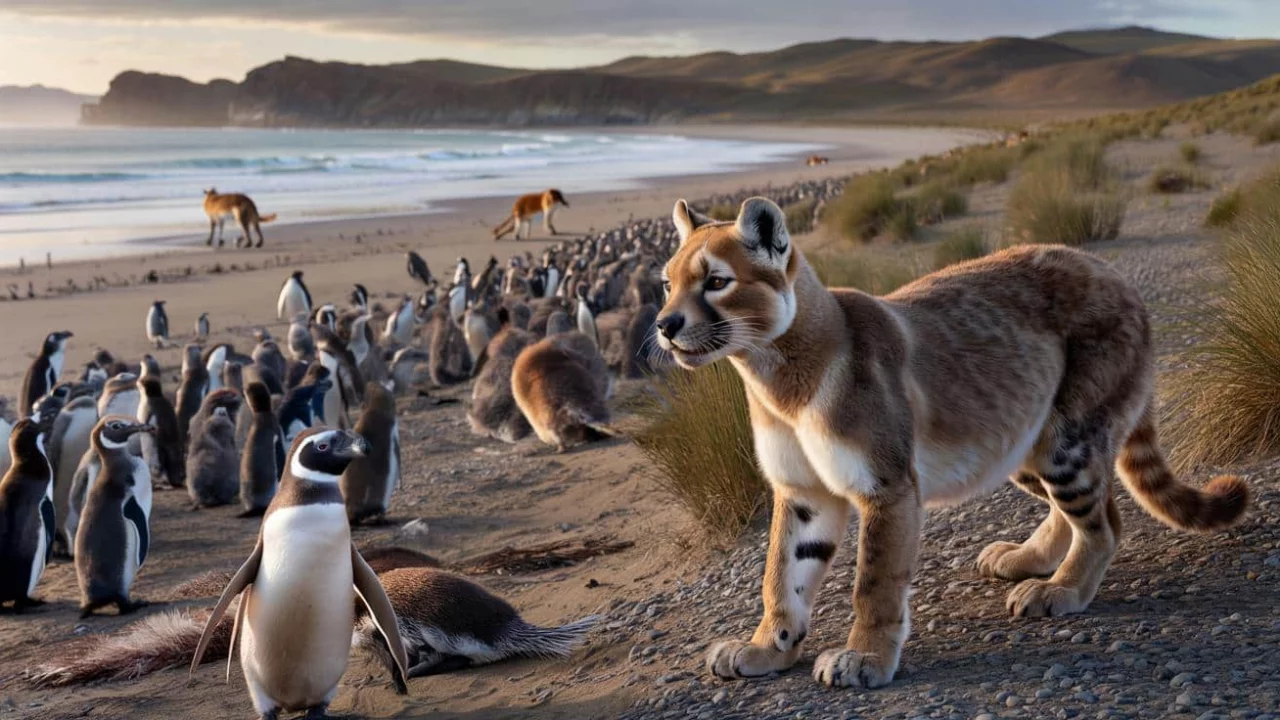
Picture this: you’re walking along a windswept beach in Patagonia, expecting to see penguins waddling across the pebbles. Instead, you spot something that makes you do a double-take—a massive mountain lion casually strolling through the penguin colony like it owns the place. This isn’t a nature documentary gone wrong. It’s the new reality in Argentina’s Monte León National Park, where pumas and penguins are rewriting the rules of predator-prey relationships.
What started as an unusual dining choice has turned into something much bigger. These big cats aren’t just snacking on seabirds—they’re completely changing how they live, hunt, and interact with each other.
The transformation began when sheep ranchers finally left the area alone, allowing pumas in Patagonia to return to their ancestral hunting grounds after decades of persecution. But they came back to find tens of thousands of Magellanic penguins had moved in, creating a mainland breeding colony that spans nearly two kilometers of coastline.
When Loners Become Social Diners
Pumas are famous for being solitary creatures. They mark their territories, avoid each other religiously, and generally prefer the bachelor lifestyle. But the penguin buffet in Monte León National Park is breaking all those rules.
Researchers discovered something remarkable when they started tracking these cats with GPS collars and camera traps between 2019 and 2023. Instead of maintaining their typical antisocial behavior, multiple pumas were showing up at the same penguin colony, sometimes within hours of each other.
“What we’re seeing challenges everything we thought we knew about puma social dynamics,” explains Dr. Maria Santos, a wildlife biologist studying the phenomenon. “These cats are essentially learning to share space in ways we’ve never documented before.”
The study, published in Proceedings of the Royal Society B, reveals that puma activity near the penguin colony was far higher than anyone expected. What researchers initially thought was quirky behavior by one or two cats turned out to be a widespread adaptation affecting the entire local puma population.
The Numbers Behind the Behavioral Shift
The data from this groundbreaking study paints a fascinating picture of how abundant food sources can completely reshape predator behavior:
| Behavior Change | Traditional Puma Patterns | New Penguin-Hunting Patterns |
|---|---|---|
| Territory Overlap | Minimal to none | High overlap near colony |
| Hunting Season | Year-round, varied prey | Concentrated during penguin breeding (Sept-Feb) |
| Social Tolerance | Extremely low | Significantly increased |
| Population Density | 1 puma per 50-100 sq km | Up to 5 pumas per 10 sq km near colony |
Fourteen pumas were fitted with GPS collars during the research period, revealing movement patterns that defied typical puma behavior. The findings show:
- Pumas were spending 60% more time near the penguin colony during breeding season
- Multiple individuals were using the same hunting corridors within 24-48 hours
- Territory sizes shrank dramatically near the abundant food source
- Aggressive encounters between pumas decreased despite closer proximity
- Female pumas with cubs were particularly drawn to the easy penguin meals
“It’s like watching antisocial teenagers suddenly decide they want to hang out at the same pizza place,” notes Dr. Carlos Ramirez, who led the GPS tracking portion of the study. “The food is so abundant and predictable that it’s worth abandoning their usual territorial instincts.”
The penguins themselves aren’t defenseless victims in this story. Magellanic penguins have sharp beaks and powerful flippers, and they nest in burrows that offer some protection. But during breeding season, when adults are focused on feeding chicks and molting birds can’t escape to the ocean, they become sitting ducks—or rather, sitting penguins.
What This Means for Patagonian Wildlife
This behavioral shift isn’t just a curious footnote in animal behavior textbooks. It’s reshaping the entire ecosystem of coastal Patagonia in ways that could have lasting consequences for both species.
The concentrated puma presence is creating what researchers call “predation pressure hotspots” around the penguin colony. While this might seem bad news for the penguins, the relationship is more complex than simple predator-versus-prey dynamics.
Conservation biologists are watching closely because this situation offers a rare glimpse into how large predators adapt to new food sources in real-time. The implications extend far beyond this single park:
- Other coastal areas with penguin colonies might see similar puma behavior changes
- Traditional puma management strategies may need updating
- Tourism in the region is being affected as visitors hope to witness this unique predator-prey interaction
- Local ranchers are reporting fewer puma attacks on livestock, possibly because the cats are too busy with penguins
“We’re basically watching evolution in action,” says Dr. Santos. “These pumas are learning new behaviors within a single generation, and those behaviors are being passed down to their cubs.”
The penguin colony itself remains stable despite the new predation pressure. With tens of thousands of birds concentrated in a relatively small area, the pumas penguins Patagonia relationship appears to have reached a natural balance. The cats are taking enough penguins to meet their needs without devastating the overall population.
Park rangers have had to adapt too. They’re now monitoring both species more closely and educating visitors about this unique ecosystem. The sight of a puma stalking through a penguin colony has become one of Monte León’s most sought-after wildlife viewing experiences.
What makes this situation particularly fascinating is how quickly these behavioral changes occurred. Within just a few years of the pumas’ return, the entire predator dynamic of the coastline shifted. It’s a powerful reminder that wildlife is incredibly adaptable when given the chance.
The ongoing research will continue tracking these behavioral changes to see if they become permanent features of coastal Patagonian ecology or if they’ll evolve further as both species continue adapting to each other’s presence.
FAQs
Are the pumas actually harming the penguin population?
No, the penguin colony remains stable with tens of thousands of birds. The pumas are taking what they need without threatening the overall population.
How unusual is it for pumas to change their social behavior like this?
It’s extremely rare. Pumas are notoriously solitary, so seeing them tolerate each other’s presence near a food source represents a significant behavioral adaptation.
Can visitors see this puma-penguin interaction at Monte León National Park?
Yes, but wildlife sightings are never guaranteed. The best chances are during penguin breeding season from September to February.
Are other puma populations showing similar behavioral changes?
This is the first documented case of pumas adapting their social structure around penguin colonies, though researchers are now looking for similar patterns elsewhere.
How long did it take for pumas to learn to hunt penguins effectively?
The behavioral shift happened remarkably quickly, within just a few years of pumas returning to the area in the mid-2000s.
What does this mean for conservation efforts in Patagonia?
It shows how resilient wildlife can be when given protected spaces and highlights the importance of letting natural predator-prey relationships develop without human interference.








Leave a Comment