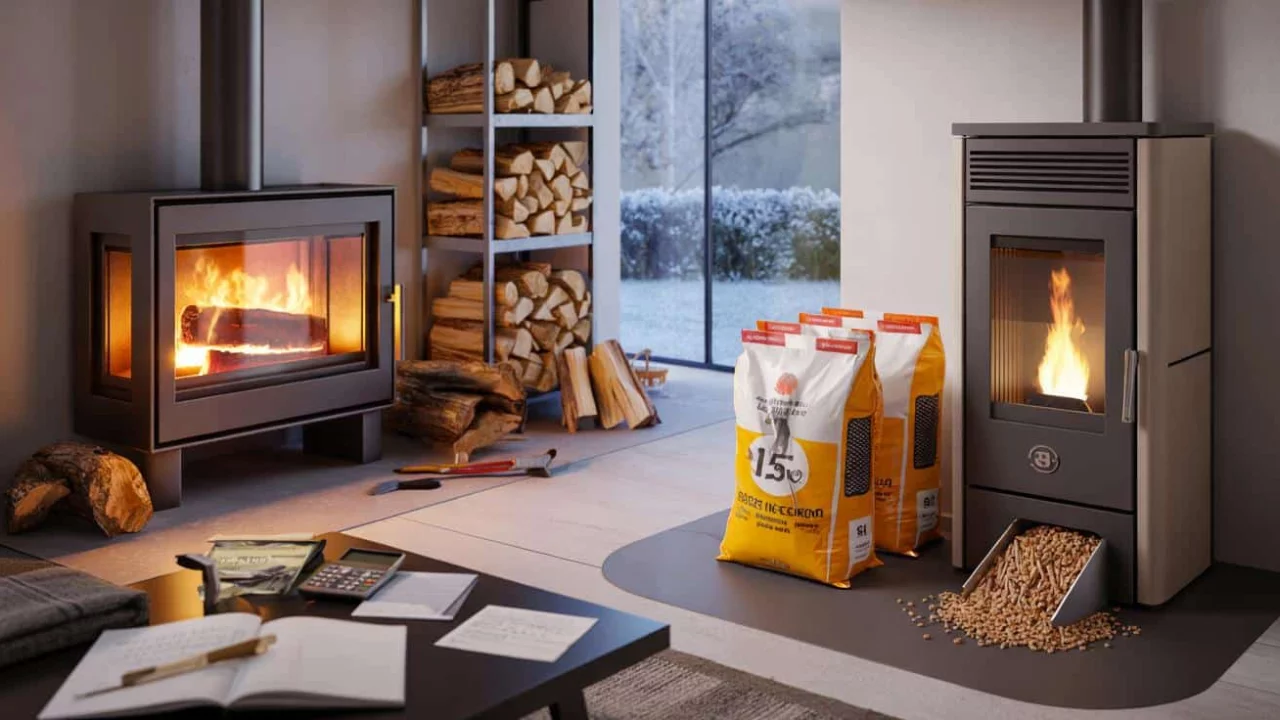
Saturday morning, first real cold snap of the year. On one side of the street, Pierre is bent over his woodpile, hands frozen, trying to split a stubborn log that bounces instead of cracking. On the other, his neighbor Claire is hauling 15-kilo bags of pellets from her car, one by one, muttering that prices have jumped. Both glance at their heating bills, at their bank apps, at the gray sky that announces a long winter.
Behind the cozy Instagram image of the crackling fire, there’s a slightly less romantic question lurking in every homeowner’s mind.
Who’s actually paying less to stay warm?
The real costs hiding behind “cheap heat”
On paper, everyone thinks they know the answer. Your uncle swears wood is almost free “if you know the right people”, while your colleague boasts about her pellet stove’s crazy efficiency. Reality sits somewhere between those two extreme coffee-break opinions.
When you start pulling out invoices, delivery slips, and electricity bills, the picture sharpens fast. The wood stoves vs pellets debate isn’t just about the price per ton. It’s about how much you actually burn, how often you use it, how much heat you’re losing through the chimney, and how heating fits into your daily life.
“Most people make their decision based on upfront fuel costs, but they’re missing half the equation,” says Tom Richardson, a heating systems installer with 15 years of experience. “A wood stove might use cheaper fuel, but if you’re only home evenings and weekends, you’re constantly restarting fires and losing efficiency.”
Take one very common scenario. A 100 m² fairly well-insulated house, in a temperate region, with a family that heats from 6 p.m. to 10 p.m. on weekdays and more on weekends. With a modern pellet stove, they might burn 1 to 1.5 tonnes of pellets per season. At current average prices, that’s roughly 400–600 euros in many regions.
The same house with a wood stove might need 3-4 cords of seasoned hardwood, costing anywhere from 300–800 euros depending on your location and whether you cut it yourself.
Breaking down the real numbers
Here’s where the wood stoves vs pellets comparison gets interesting. The fuel cost is just the beginning of your actual expenses.
| Cost Factor | Wood Stoves | Pellet Stoves |
|---|---|---|
| Fuel (annual) | $300-800 | $400-600 |
| Initial equipment | $1,200-3,500 | $1,800-4,000 |
| Installation | $800-1,500 | $1,000-2,000 |
| Electricity use | $0 | $50-120/year |
| Maintenance | $100-200/year | $150-300/year |
“The hidden costs add up faster than people expect,” notes Sarah Martinez, an energy efficiency consultant. “Pellet stoves need electricity to run their fans and augers. Wood stoves need more frequent chimney cleaning. Both need regular maintenance, but pellet stoves have more moving parts.”
The efficiency gap matters more than most homeowners realize. Modern pellet stoves typically achieve 75-90% efficiency, meaning most of the fuel’s energy actually heats your house. Traditional wood stoves often run 60-75% efficiency, though EPA-certified models can reach 80%.
What this means in practice: If you’re burning $500 worth of pellets at 85% efficiency, you’re getting $425 worth of actual heat. That same $500 in wood at 65% efficiency gives you $325 worth of heat. The math starts shifting pretty quickly.
But efficiency isn’t everything. Wood stoves excel in different scenarios:
- You have access to free or very cheap wood
- You enjoy the hands-on process and physical work
- Power outages are common in your area
- You’re home most of the day to tend the fire
- You have adequate storage space for seasoned wood
Pellet stoves shine when:
- You want automated heating with minimal daily input
- Storage space is limited
- You have irregular schedules
- Local wood supplies are expensive or unreliable
- You prioritize consistent heat output
Who wins in the real world?
After crunching numbers from dozens of households, the answer isn’t what you’d expect. The most economical choice depends entirely on your specific situation, not just the sticker price of fuel.
Wood stoves typically come out ahead financially if you can source wood for under $200 per cord and you’re home regularly to maintain fires. The break-even point usually hits around $250-300 per cord, depending on your pellet prices.
“I track every penny of heating costs,” says Mike Chen, who switched from pellets to wood three years ago. “With wood at $180 per cord from a local farmer, I’m saving about $200 per winter. But I’m also spending 2-3 hours per week on splitting, stacking, and fire maintenance.”
Time investment is the wild card that shifts the equation. Wood heating demands active participation. You’re splitting, stacking, starting fires, adding logs, cleaning ash, and dealing with smoke on windy days. Pellet stoves ask you to fill a hopper every few days and press buttons.
Geography plays a massive role too. In areas with abundant forestry, seasoned hardwood might cost $150-250 per cord. In urban areas or regions without local wood sources, the same amount could run $400-600. Pellet prices tend to be more stable nationally, typically ranging from $250-350 per ton.
“Location trumps almost everything else,” explains David Kim, who installs both systems across three states. “Rural customers with wood access almost always save money with wood stoves. Suburban customers usually find pellets more practical and often more economical once you factor in convenience.”
The verdict? Wood stoves vs pellets isn’t really about which system is universally cheaper. It’s about matching the system to your lifestyle, location, and priorities. If you have cheap wood access and enjoy the process, wood wins on pure economics. If you value convenience and consistent performance, pellets often deliver better value despite higher fuel costs.
Both Pierre and Claire might be making the right choice for their specific situations. The real question isn’t which system costs less in a spreadsheet, but which one fits your life while keeping you comfortably warm all winter long.
FAQs
How much wood do I need compared to pellets for the same heat?
Generally, one ton of pellets equals about 1.5 cords of hardwood in terms of heat output, though this varies by wood species and moisture content.
Do pellet stoves work during power outages?
Most pellet stoves require electricity to operate their fans and feed systems, so they won’t work during outages unless you have a backup power source.
Which system requires more maintenance?
Both need regular cleaning, but pellet stoves have more mechanical components that can break down, while wood stoves require more frequent ash removal and chimney maintenance.
Can I burn any type of wood in a wood stove?
You should only burn seasoned hardwood with less than 20% moisture content. Avoid treated lumber, pine, or green wood, which create creosote buildup and reduce efficiency.
How long do wood stoves and pellet stoves typically last?
Quality wood stoves can last 20-30 years with proper maintenance, while pellet stoves typically last 15-20 years due to their more complex mechanical systems.
Which option is better for the environment?
Both are considered carbon-neutral since they burn renewable biomass, but pellets often have a smaller carbon footprint due to higher efficiency and more consistent burning.











Leave a Comment